The Real Cost of Divorce After 50 (And How to Not Pay It)
Divorce is never easy. But divorce after 50? That's a completely different animal.
We're talking about decades of accumulated assets, retirement accounts, Social Security decisions, healthcare coverage, and tax consequences that can follow you for the rest of your life — and one wrong move can cost you far more than just the marriage.
In this episode, I'm breaking down the real financial damage of what's called "Gray Divorce"; the mistakes I see people make in practice, and exactly what you need to do to protect yourself.
More specifically, I discuss:
- Gray Divorce Study – What Divorcees are saying about retirement and finances post-divorce
- The difference between divorce after 50 versus divorce in your 30s and 40s
- The differing realities of men vs. women post-divorce
- Mistakes during and after the divorce process regarding retirement savings
- Social Security and healthcare decisions post-divorce
- Making key financial decisions under pressure and common regrets
Resources From The Episode:
-
- Retired-ish Newsletter Sign-Up
- Get Cameron's Book for Divorcées & Widows!
- Previous Episode: Divorced, Widowed, and Wondering: How to Maximize Your Social Security Benefits
- Previous Episode: Should I Get A Medicare Supplement or Advantage Plan?
- Previous Episode: How Are Restricted Stock Units (RSUs) Treated in a Divorce?
The Key Moments In This Episode Are:
03:04 Uncertainty in Retirement Planning for Divorcees
06:38 Retirement Savings Mistakes
11:11 Financial Blind Spots and Costly Decisions in Divorce
14:27 Social Security Claiming Risks Post-Divorce
21:11 Health Insurance Decisions Post-Divorce
24:40 Seeking Professional Financial Guidance During & After Divorce
Divorce is never easy, but divorce after 50? That's a completely different animal. We're talking about decades of accumulated assets, retirement accounts, Social Security decisions, healthcare coverage, and tax consequences that can follow you for the rest of your life. And one wrong move can cost you far more than just the marriage. Today, we're breaking down the real financial damage of what is called gray divorce, the mistakes I see people make in practice, and exactly what you need to do to protect yourself.
00:00:59
I recently read an article that intrigued me enough to the point that I decided to produce an entire podcast episode about some of the findings in that article compared to what I see in practice, and how they are similar and how they differ altogether. I did find it very fit and relevant for today's 50-and-over population. It was a study done by a life insurance company called Western Southern Financial Group about what's dubbed gray divorce, which is essentially the new age way of referring to divorce after age 50.
00:01:34
It is a fact that gray divorce is often much, much different than a divorce, say, in your 30s or 40s and beyond, because after your 50s, you're typically in a completely different stage of life. Oftentimes, there are no longer younger children that are part of your household. You might be in your peak earning years, or your spouse might be. You likely have accumulated a good amount of assets by now. You may have a lot less long-term debt than you used to have, or even consumer debt. For example, maybe your mortgage is almost paid off, or it is paid off for those of you that are pretty aggressive. Maybe you no longer have any student loans, things like that.
You may also be getting close to making decisions on things like Social Security or Medicare, or you may be taking care of your own parents, or your parents may have recently passed away, and maybe you're inheriting some sort of wealth. There's just a lot of things going on during this phase of life that is much, much different than when you are younger, just starting your career or having young children to raise. So if you find yourself going through divorce after 50, just know that while there might not be complications that arise around things like child custody, you can definitely have a very complex situation and a potential thunderstorm of financial issues. The good news is I'm going to try and help you identify some of that stuff today.
00:03:05
The study says that 64% of Americans who divorce after age 50, again, a.k.a. gray divorce, say it delays their retirement. 52% said it pushed retirement back by 3 years or more. And 67% say they take on new debt post-divorce, typically between $25,000 and $50,000. The study surveyed 235 US adults who reported being divorced at age 50 or older, and the sample was 69% male and 31% female. However, regardless of what this one small study says, in practice, I will tell you that the financial damage over a lifetime for many divorcees is often much worse than just some potential new debt and delaying retirement. And that is, of course, unless proper planning is done before and after the divorce.
00:04:06
While male respondents more often reported longer retirement delays, female respondents more frequently said that the split left them uncertain or without a clear retirement plan. And that was 26% of women versus 7% of men. Those two statistics can be for a variety of reasons. That is actually a very common feeling for women going through gray divorce, the feeling of uncertainty and the unknown when it comes to obtaining some sort of financial freedom and maybe retiring someday.
00:04:40
For some households, this is because the man can be the breadwinner and may control a lot of the money, handle the investing, things like that. And many times the spouse is left in the dark when it comes to the long-term finances. But as you know, that is not always the case. There are, of course, households where the woman or one of the spouses, for those in same-sex marriages, is the primary breadwinner and is incredibly dedicated emotionally and intellectually to their career. And at the same time are either taking care of adult children or maybe all the way into the children's college years and beyond, and possibly caring for their own aging parents or maybe even their in-laws. So naturally, these women who are also the breadwinners find little interest in or simply can't dedicate enough time to things like retirement planning and understanding investing and taxes, yada yada, and this is referred to as the sandwich generation. From what I've seen, it's typically one of these two situations that often leaves women very uncertain about the future and in need of a clear retirement plan when it comes to life after divorce. So much so that I've actually written a book to help divorcees and even widows that you can find in the link in the episode show notes if you're interested.
00:06:07
The article also states that nearly 60% of respondents reported losing at least 25% of their retirement savings during the divorce process, including more than 1 in 4 who lost 50% or more. And they reported this was due to things like early withdrawals, poor planning, or even uneven asset division. I agree with this for the most part, but there are some important nuances here that I think people need to understand. Based on your state laws, the asset division doesn't necessarily need to be exactly even. Even if it is, it doesn't mean every single asset that is a part of the divorce needs to be divided. There can be negotiations and alternative methods of asset division that are agreed upon by both the parties. In other words, someone might say that they lost most of their retirement savings during the divorce, but if they got to keep all the equity in the home in lieu of giving up more of the retirement money, they can't say they lost their retirement savings due to the divorce itself. That was something they agreed on, and it isn't necessarily forced upon you.
00:07:25
It's all about Decision-making, right? I guess what I'm trying to say is just because you get divorced does not mean you will lose all of your retirement savings. However, it is true that many people lose more retirement savings than they should, not just because of divorce. This happens all the time simply because people don't plan very well ahead of retirement, trying to gather everything together in the year you decide to retire. Or 2 months before is not good planning.
00:07:56
Many times, people make the mistake of confirming with themselves that they are going to retire as of a specific date, even though they haven't done the planning yet. It doesn't matter at the end of the day what their financial situation is. When they lay everything out, they've already made the decision that they're going to retire, so they try and make their finances fit the retirement. Even if it's not really feasible in the long run. This is what leads to very expensive mistakes and regret.
00:08:28
Think of it like this. You're house hunting to find your dream home, and you find the perfect one. So you list your house for sale and put a contingent offer on the dream home. Your house doesn't sell for nearly as much as you expected, and now you have to come up with additional funds in order to get that dream home. You are so in love with this home that you will do whatever it takes to get into it. You've already committed mentally and emotionally. You go get a loan that's more than you can really afford, or worse, you break into other savings like retirement savings and pay additional taxes and penalties to get that money to make up for it. You had already made the decision that you were going to get that home no matter what. And because of that, you end up making decisions that hurt you financially in the long run.
00:09:19
The divorce process can actually open up the gates for even more mistakes. For example, during a divorce, if one spouse has a 401(k) plan and has agreed to divide some of the 401(k) plan assets with their soon-to-be ex-spouse via a QDRO, also called a Qualified Domestic Relations Order, the receiving spouse, known as the alternate payee, will typically get a one-time opportunity to take a cash distribution from their share of the plan assets and avoid the 10% penalty for early withdrawals if they're under age 59 and a half at the time. This rule exists so that there is some extra liquidity available in case there are a few other liquid assets that are part of your divorce. However, just because you can take that distribution and avoid that penalty doesn't mean you should.
00:10:21
A couple things to know is that even though you may avoid that 10% penalty, you will still be subject to income taxes on that money. And by taking a withdrawal of cash, there will be less money in the tax-deferred retirement account that is compounding over time. And when you combine tax deferral with the power of compounding, that can be extremely powerful. Even though this rule can be a lifesaver for some divorce— divorcees that are in a cash flow pinch and have nowhere else to go, getting immediate access to retirement money right in the middle of a divorce or after the divorce and finding ways to spend it while your emotions are all over the place can be very disastrous. And this is one of those decisions you can easily regret in no time.
00:11:12
If you were the homemaker and at the same time, not the one doing any of the investing or saving, it can sometimes feel like a windfall, almost like an inheritance, even though it was always there. And yes, you still earned it by taking care of the home, even though your spouse was the one saving it. And it was meant to supplement retirement income for you and your spouse initially. If you are largely in the dark most of your adult life regarding the savings and the investments, it can be somewhat of a shock when you receive your portion of the assets post-divorce or when you get into the divorce and you're suddenly learning about all of the savings and investments that you actually have.
00:11:59
This can lead to issues like overspending post-divorce because you may feel that you now have so much money that there's no way it can run out, right? This won't be everyone's situation, but this does happen. And oftentimes it causes you to become too conservative when it comes to investing that money on your own afterward because you don't know much about investing, and you haven't been solely responsible for such dollar amounts before in your life. And as we've talked about many times before on this podcast, being too conservative with your investments is still a significant risk in retirement. And this is because inflation and taxes will slowly eat away at that money over time. And when combined with overspending in retirement, this can easily evaporate your entire retirement savings before you know it. The opposite is also true. If you were largely in the dark about large debts that have built up during the marriage, the divorce process may reveal some huge liabilities that need to be dealt with. Sometimes, spending decisions are made too quickly and without thinking about things like tax consequences or early withdrawal penalties on retirement accounts. And sometimes divorce negotiations are finished without thorough enough planning for your cash flow afterward, which can make some divorces end up fairly inequitable when they seemed fair when you signed the documents.
00:13:36
A prime example of this is when you become dead set on keeping the house even though it was barely affordable to begin with. In order to do this, you likely need to buy your ex out of the home. You need to buy their portion of the equity out of the home, which will cause you to get a loan or give up other assets that are a part of the divorce. Now you're house rich and cash poor, but hey, you got the house, right? So it feels like a win, but actually puts you in a terrible situation when it comes to your income throughout the rest of your retirement, so you might still be forced to do things like go back to work or work longer and delay retirement. Whereas if you made different decisions throughout the divorce process, you might not have had to do that.
00:14:27
Okay, moving on. About 71% of the respondents said they claimed Social Security earlier than planned, locking in reduced benefits. And 69% reported losing access to a spouse's health insurance. Social Security and healthcare are some of the biggest decisions that you should be concerned with if you're divorcing after age 50. It is critically important to understand your options for Social Security benefits, available health insurance, and your options for Medicare, because that is going to become very important at age 65. Or older if you're still working.
00:15:09
As I'm sure you know, health insurance is incredibly expensive. Medicare is a maze of rules, deadlines, exceptions, and penalties. And depending on how well you and your spouse have saved for retirement, Social Security benefits may make up a large portion of your income for the rest of your life. When it comes to Social Security, you may have your own retirement benefits that you earned from working over your lifetime, but you may also be eligible for benefits based on your ex-spouse's work record or even a deceased spouse's record. Each of these different benefits has specific rules for eligibility and amounts that are available at differing ages. And we've talked about things like ex-spousal benefits at length in a previous episode. So rather than go through that again here, I will be sure to include a link in the episode show notes. So be sure to check that out. However, you should never let the fact that spousal benefits exist deter you from establishing or increasing your own retirement benefits. Taking benefits too early can cause real damage over the rest of your lifetime, especially now that people are living much longer, and women especially live much longer than men, on average about 6 years longer.
00:16:34
You'll want to be careful of claiming benefits before your full retirement age while you are also working. Many people that are working and are younger than their full retirement age, which the Social Security Administration lets you know what your full retirement age is, depending on the year you were born. Again, many people that are working and are younger than that full retirement age think that they should take Social Security benefits as soon as they can, so that it can supplement their income immediately after divorce, because they need the income for their new standard of living.
00:17:11
However, working and filing for benefits before full retirement age will result in a partial or full benefit withholding if earnings exceed what is called the annual earnings thresholds, which are not hard to exceed. If you're between age 62 and your full retirement age, your Social Security benefit is reduced by $1 for every $2 that you earn over $24,480 in 2026. If you're in the year that you turn your full retirement age, up to the month before your birthday, your benefit is reduced by $1 for every $3 over $65,100 in earnings. And again, this is only if you are working and you are earning those amounts of money or more, right? If you're not working, then they're not going to withhold and pull back benefits. However, if you claim before your full retirement age, you will have a permanently lower Social Security amount for the rest of your life.
00:18:19
Once you reach your full retirement age and beyond, there is no limit on what you can earn. That earnings test no longer applies. So that's when you're in the clear. You can continue working past your full retirement age all you want while also collecting your Social Security benefit again, if you wanted to take it at that time, and have nothing held back. However, this still does not mean that you should always take your benefit at your full retirement age. Again, this is where planning can make a tremendous impact on the income you receive over the rest of your lifetime. Also, it's important to know that not all types of income count as earnings for the purposes of that earnings test that we just went over. And actually, most types of income that are exempt from the earnings test will be related to your divorce. So these are things like any rental property income, dividends from an investment portfolio, any IRA or pension income that you might receive, any deferred compensation, a spouse's earned income in the case that you get remarried, unemployment compensation, and even alimony or spousal support.
00:19:37
Again, if you must claim your Social Security benefits early because you need the income and you have no other income, make sure you plan accordingly. Since longevity is such an important planning factor nowadays, where people are living much longer, delaying Social Security as long as possible may be in your best interest. Depending on potential spousal support and assets that are received post-divorce, you may be able to bridge your income to help you delay claiming benefits. It may be more tax efficient as well since you will be filing single and can exhaust pre-tax assets like money in IRAs or 401(k)s at lower tax brackets before collecting Social Security and causing more of your Social Security to be taxed in the future. This can help also reduce required minimum distributions from your retirement accounts in your 70s and beyond, and therefore potentially help you avoid Medicare surcharges on your premiums and losing valuable tax deductions such as the enhanced senior deduction. These are all things that you can do when delaying your Social Security benefit longer. If you take it sooner than later, you are kind of limiting yourself on strategies and things that you can do. Again, depending on the other assets that you'll have post-divorce. So planning is prudent here.
00:21:12
Let's talk health insurance, since I know this one's really important and can be very confusing, and it's on many people's minds. If this is a vital component of your divorce, one of the biggest stressors that you have, you may want to consider something like a legal separation instead of a full-blown divorce in order to maintain the current health insurance. And again, this just depends on your situation. This is assuming that, hey, if your spouse has great health insurance through their employer and you're also on that health insurance, this is where something like a legal separation might help. This can accomplish some of the outcomes that you might desire from a traditional divorce, but will also allow you to take advantage of some of the benefits of being married. Such as staying on your spouse's employer health plan. Now, that's just one thing. That's one strategy. There are many other things that you can do. If you're under age 65 and you're not going to be able to participate in your spouse's health plan, or you're not going to do a legal separation, you are going to do a full-blown divorce, you are going to have to purchase your own health insurance plan. Which will likely be very expensive.
00:22:30
Or if you're still working, your employer may offer a health plan. Maybe you're already on that healthcare plan, so it's not really not going to affect you. Again, this is situation by situation. And by the way, because the health insurance is likely to be more expensive post-divorce, you need to be including this in your planning during the divorce process and during the negotiations. You have to be able to get an idea of what your income will look like when the dust has settled and what your expenses will look like. This will help in that negotiation process. If you just go through it blindly and say, okay, this is what I have, well, those expenses can start eating into what you have. And like I said before, a divorce that seemed equitable at the beginning may not seem very fair anymore. Eventually, at age 65 or older, you will move on to Medicare. And it's important to understand what kind of coverage that you can afford and what kind of coverage you should choose depending on the rest of your financial picture and your lifestyle.
00:23:41
Do you travel a lot? Do you want concierge service? Are you used to having a phenomenal healthcare plan, and you want to continue with that kind of service and access to healthcare? Do you want to be restricted to a network? Do you want to skip the referral process? Will the income sources you expect to receive in retirement increase with premium inflation? These are some of the questions you need to ask yourself before deciding on the type of additional Medicare coverage that you will eventually go with, such as a Medicare Advantage plan or a Medicare Supplement plan, and what type of each, because there's thousands of Medicare Advantage plans and several Medicare Supplement plans. Again, we have done podcast episodes at length about Medicare in the past. I again will include a link in the episode show notes. So if you're interested in that, check it out.
00:24:40
Okay, circling back to the article here, many respondents said they made key financial decisions under pressure and without sufficient guidance. Common regrets included not negotiating a better settlement, failing to build independent retirement savings earlier, and misunderstanding how to divide retirement accounts. Others cited a lack of budgeting strategy and debt management planning. My advice to you would be to get professional guidance, of course, if that wasn't clear by now. There are so many moving pieces to a divorce, especially if you are the party that was not privy to the finances, or at least the investments and the savings. These will be key components to your income in retirement and, therefore, your life post-divorce in your 50s and 60s. So you can't risk getting this wrong and making costly mistakes.
00:25:44
For instance, do we split any and all retirement accounts down the middle, or do I negotiate for the Roth IRA versus the 401(k) or the traditional IRA? Do I want some of the home equity, or would I rather take some other asset in lieu of? How will I fare on my own with certain assets after taxes since they all work differently? How should we handle the current life insurance coverage? Should I take a lump sum of cash in lieu of some alimony or claim to future benefits or bonuses and stock awards that my spouse may have? Maybe there are equity awards at stake right now, and they need to be accounted for appropriately for asset division or spousal support. Again, we even have previous episodes on stock awards specifically in divorce.
00:26:38
Yes, professional guidance will cost you money, but oftentimes this ends up being pennies compared to the real cost of entering gray divorce without knowing what you're doing, because the mistakes that are made compound over the rest of your life. So the actual cost is massive. I have personally seen these costs easily range from the tens of thousands to hundreds of thousands of dollars over a lifetime. So don't step over the dollar to pick up the penny. Get the advice you need, and please, please do not solely rely on your family law or divorce attorney. They serve a very specific purpose and important role in the divorce process. But more often than not, they will not be able to do an adequate enough financial and tax analysis to get you to the best possible long-term financial results on their own. You should get a financial or tax advisor involved as well.
00:27:41
One last tip for you. If you think the divorce process is a good time to seek revenge on your ex, think again. This will only make the process last longer and will present more problems, which will cost not just them, but you more money in the end.
00:28:00
That does it for today's episode. Make sure to check out the various links that we have provided in the episode show notes. If you find the topics discussed in today's show actionable and insightful, do yourself a favor and subscribe to or follow the show on your podcast app. That way, you can get alerts each time a new episode drops. Also, be sure to check out our free Retired-ish newsletter to get more useful information on retirement planning, investments, taxes, divorce, you name it, once a month straight to your inbox. The newsletter dives deeper into some of the topics we discuss on the show, as well as provides some useful guides and charts available for download. As always, you can find the links to the resources we have provided in the episode description right there on your podcast app. Or you can head over to RetiredishPodcast.com/95. Thanks again for tuning in and following along. See you next time on Retired-ish.
00:29:17 Disclosures
Cameron Valadez is a registered representative with, and securities and advisory services are offered through LPL Financial, a Registered Investment Advisor, Member FINRA/SIPC. Neither LPL Financial nor its registered representatives offer tax or legal advice. Always consult a qualified tax advisor for information as to how taxes may affect your particular situation. The opinions voiced in this podcast are for general information only and are not intended to provide specific advice or recommendations for any individual. To determine which strategies or investments may be suitable for you, consult the appropriate qualified professional prior to making a decision. All investing involves risk, including loss of principal. No strategy assures success or protects against loss. Contributions to a traditional IRA may be tax-deductible in the contribution year, with current income tax due at withdrawal. Withdrawals prior to age 59 ½ may result in a 10% IRS penalty tax in addition to current income tax. A Roth IRA offers tax deferral on any earnings in the account. Qualified withdrawals of earnings from the account are tax-free. Withdrawals of earnings prior to age 59 ½ or prior to the account being opened for 5 years, whichever is later, may result in a 10% IRS penalty tax. Limitations and restrictions may apply. This information is not intended to be a substitute for specific individualized tax advice. We suggest that you discuss your specific tax issues with a qualified tax advisor. Tax and accounting-related services offered through Plan-It Business Services DBA Planable Wealth. Plan-It Business Services is a separate legal entity and not affiliated with LPL Financial. LPL Financial does not offer tax advice or tax and accounting-related services.
Cameron Valadez is a registered representative with, and securities and advisory services are offered through LPL Financial, a Registered Investment Advisor, Member FINRA/SIPC.
Neither LPL Financial nor its registered representatives offer tax or legal advice. Always consult a qualified tax advisor for information as to how taxes may affect your particular situation.
The opinions voiced in this podcast are for general information only and are not intended to provide specific advice or recommendations for any individual. To determine which strategies or investments may be suitable for you, consult the appropriate qualified professional prior to making a decision.
All investing involves risk including loss of principal. No strategy assures success or protects against loss.
Contributions to a traditional IRA may be tax deductible in the contribution year, with current income tax due at withdrawal. Withdrawals prior to age 59 ½ may result in a 10% IRS penalty tax in addition to current income tax.
A Roth IRA offers tax deferral on any earnings in the account. Qualified withdrawals of earnings from the account are tax-free. Withdrawals of earnings prior to age 59 ½ or prior to the account being opened for 5 years, whichever is later, may result in a 10% IRS penalty tax. Limitations and restrictions may apply.
This information is not intended to be a substitute for specific individualized tax advice. We suggest that you discuss your specific tax issues with a qualified tax advisor.
Tax and accounting related services offered through Plan-It Business Services DBA Planable Wealth. Plan-It Business Services is a separate legal entity and not affiliated with LPL Financial. LPL Financial does not offer tax advice or tax and accounting related services.
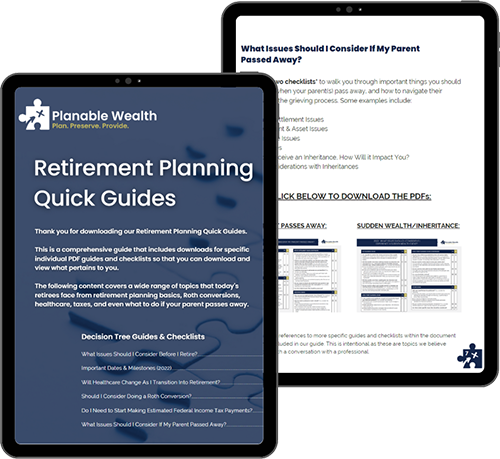
Get your free
RETIREMENT PLANNING QUICK GUIDES [PDF]
Get instant access to several free PDF flowcharts and checklists that cover a wide range of topics that today's retirees face from retirement planning basics, Roth conversions, healthcare, taxes, and even what to do when your parent passes away.
"*" indicates required fields