How to Mitigate Taxes & Diversify a Large Stock Position: Part 1
You've watched one stock turn into more money than you ever expected. And now you can't bring yourself to sell it — because the second you do, the IRS gets a check with a lot of zeros on it and you come to the realization that you are not going to receive all of that money you've been looking at on paper all these years.
But on the flip side you're also wondering how that money can change your life and all the things you can do for you and your family.
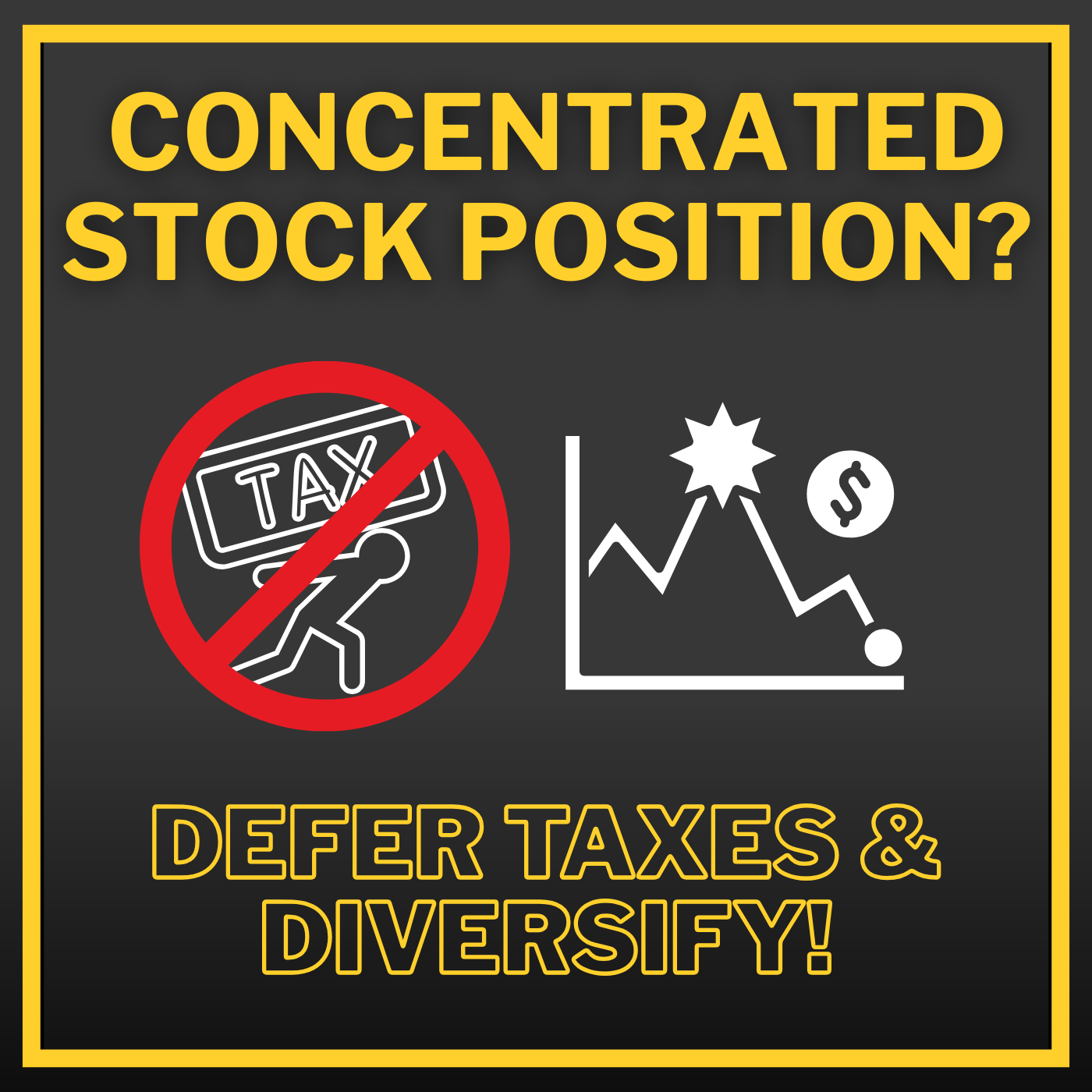
In this episode, we're talking about what that fear of taxation can actually cost you, and some ideas to help you take risk off the table and mitigate the inevitable tax bill.
More specifically, Cameron discusses:
- Why a concentrated stock position carries more risk than you think
- Worry more about taxes from selling or a sell off in your biggest stock position?
- Strategies to defer taxes or diversify a concentrated stock position
- Direct indexing
- Charitable giving strategies for large, embedded stock gains
Resources From The Episode:
The Key Moments In This Episode Are:
(04:09) Why a concentrated position is sneakier than it looks
(09:37) Which is the bigger threat: taxes or concentration risk?
(11:41) Thought experiment: selling today vs. waiting and potentially losing value
(14:46) The biggest misconception: taxes vs. concentration risk
(17:35) Strategy 1. Just sell it
(18:56) Strategy 2. Hold on to it until death and receive the step-up in basis
(21:10) Strategy 3. Gifting to family
(25:23) Strategy 4. Direct indexing
(31:04) Strategy 5. Charitable giving
You've watched one stock turn into more money than you ever expected, and now you can't bring yourself to sell it. Because the second you do, the IRS gets a check with a lot of zeros on it, and you come to the realization that you're not going to receive all of that money you've been looking at on paper all these years. But on the flip side, you're also wondering how that money might have been able to change your life, and all the things that it could do for you and your family. Today we're talking about what that fear of taxation can actually cost you, and some ideas to help you take risk off the table and mitigate the inevitable tax bill.
00:01:05
Let me describe two different people to you really quick. Person one worked at the same company for close to 40 years and received a lot of compensation via employer stock along the way. Never sold a share of stock because every time invested, or every time a new award was earned, it just felt wrong to sell the company. Today, that position is worth more than their house, their retirement accounts, and pretty much everything else they own combined. Person number two is 55 years old, still working, also received a lot of compensation via employer stock awards. In fact, is still vesting new restricted stock units every quarter, and have two different flavors of equity compensation: those RSUs I just mentioned, and some incentive stock options from the same publicly traded employer. Every raise, every bonus, every promotion just adds more of the exact same stock to a pile that's already enormous. Both their net worth and their income, essentially their entire livelihood, rely on the company they work for.
00:02:15
If either of those sounds like you, this episode is specifically for you, because today we're talking about concentrated stock positions, meaning you have a lot of money tied up in one or maybe a few publicly traded companies, or even just a lot of money tied up in some sort of asset. We will talk about why this situation can be very dangerous, even when the stock has been a rocket ship in terms of performance, and some ideas for dealing with them without torching yourself on taxes. In this episode, part one, we're going to walk through real strategies that you might consider, depending on your priorities. And then in part two, the next episode, we are going to run through multiple hypothetical case studies so that you can see how this actually plays out with some real numbers. And even if you don't necessarily have any employer stock, you know, you didn't work for anyone that had stock that you could be awarded through some sort of plan, like an ESOP plan, or maybe you didn't work for a publicly traded company, but maybe you were gifted stock, or you started investing in a company or cryptocurrency early on, and you still have a very large position in one or a few of these individual assets. Most of this episode is still going to apply to you.
00:03:32
I want to say upfront, the strategies that we cover today is just a slice of what's actually available. There are more tools in the shed than we have time for in one episode. There are layered strategies, more advanced trust structures, the use of leverage in your portfolio, and things that are specific to even your state or your company's plan documents if you do get those employer stock awards. Nothing here is a substitute for sitting down with your own advisor and your own tax professional and running your actual numbers and situation. This is education, not a recommendation for you personally.
00:04:09
So let's start by talking about why this problem is sneakier than it looks. Here's the thing about one or two concentrated stock positions. It doesn't feel like risk while the stock is going up in value, especially if it happens to go up pretty substantially over a few years in a row, or over an even shorter timeframe, like over the last several months. It feels like the smartest financial decision you ever made. And then one day it isn't, because the stock price gets demolished for one reason or another. Maybe it's the latest earnings report, if it's a publicly traded stock, or maybe there was some internal fraud or some existential economic crisis that just kind of brings everything down. It can be anything. By then, the tax bill for fixing this problem has also gotten enormous, right? Before we get into any ideas or strategies to help with this issue, I want to make sure you understand the shape of the problem, starting with the tax brackets you're actually working with, at least currently in 2026. For individuals, ordinary income brackets run from 10% up through 37%, and that's for federal taxes. With that top rate of 37%, kicking in over roughly $640,000 of taxable income for people that file single. Now, if you file married filing jointly, that top tax bracket of 37% starts at around $769,000. Ordinary income consists of most types of income that you generate throughout your life. Some examples are regular income from working, so W-2 wages or your salary. It could be self-employment income from running a business. It could be rent from rental real estate, royalties, distributions from qualified retirement accounts, such as your traditional IRAs, 401(k)s, and the like.
00:06:13
On the other hand, capital gains tax brackets are separate and, frankly, a lot more forgiving. Long-term capital gains means you've held a capital asset more than a year, and it's not in a qualified retirement account. There are different ways or different rates that that capital asset could be taxed at if it's long-term. It can be taxed at 0%, meaning nothing. It could be taxed at 15% or 20%, depending on your total taxable income. That includes kind of everything across the board. For an individual, if you're in the 0% capital gains bracket, which goes up to about $50,000 of taxable income, then you have 15%, which goes up to roughly $545,000 in income, and then it's 20% above that. And again, for those that file married filing joint, it's a little bit higher.
00:07:15
In fact, if you want a quick cheat sheet that references all of these figures, our firm has a great one that's available for download inside of our monthly newsletter. So if you haven't seen that yet, be sure to subscribe to our free newsletter, and you can download that in next month's issue. Now, layer on what is called the net investment income tax. This is the extra 3.8% Medicare surtax that applies to investment income once your MAGI crosses $200,000 if you're single, or $250,000 if you file married filing joint. Don't worry about that MAGI term that I just gave you, at least at the moment. Just know that if your income is around those figures, you might be subject to an additional 3.8% tax on top of the capital gains rates that I just mentioned.
00:08:11
It's not part of the official capital gains bracket, but functionally, once you're above those thresholds, your real marginal rate on your long-term capital gains jumps from 15% to 18.8%. And once you're in the top bracket, it's effectively 23.8% instead of just the 20%. And here's a fun fact that surprises people. The combined maximum federal rate most investors will ever pay on a long-term capital gain is 23.8%. Compare that to the 37% top ordinary income tax rate. That gap is exactly why so much of what we're going to talk about is engineered around preserving that capital gains treatment, where you already have it, and spreading recognition of those taxable gains across multiple years to try to get an even lower capital gains brackets, like that 15% bracket, or maybe the 0%. Rather than either losing that favorable tax treatment or just dumping everything into one really expensive and unnecessary bracket-busting year, especially if you live in a state that taxes capital gains as well. In these cases, the tax bill can obviously be much bigger.
00:09:37
So the question is, do we worry more about these tax issues, or the tax bill that you're going to pay if you sell, or the inevitable stock price downturns that will occur as you hold on to these positions? Which one is likely to hurt you the most? Which one is more likely to derail your hopes and dreams and your financial and your retirement plan?
I want to run a quick thought experiment here, because I think it reframes how people think about waiting for a better time to sell, right? If we have these positions and they're whipsawing up and down in the market, we're always asking ourselves, do I sell some now? Do I sell any? Do I just hold on to it forever? You know how that is if you're one of these people that has a concentrated stock position.
00:10:24
So let's say you're married and you're taking the standard deduction on your tax return. You have absolutely no other income, okay? This is a hypothetical example. And you own a single stock worth $1,000,000, and your basis in that stock is $100,000, meaning you have a $900,000 taxable gain if you were to sell all of the shares of that stock today. If you sell today, here's the rough math. You would fill that 0% capital gains tax bracket that we talked about earlier, then the 15%, then some of it spills into that 18.8 bracket because that net investment income tax kicks in, and a little bit even touches the 23.8% bracket. So the total tax bill is roughly $152,740, and this equates to an effective tax rate, which means the actual amount of federal taxes you paid on that $900,000 gain of just under 17%. And the cash in your pocket at the end of the day after taxes is about $847,000.
00:11:41
Now, imagine you didn't sell. You just can't see yourself paying that tax bill. Or maybe you're sitting there hoping and waiting for some silver bullet to come along where you might actually be able to spend that whole million dollars without paying any taxes. That'd be nice, right? So you waited, hoping for a better tax year, or just out of loyalty to the stock or the company. Then the market, for whatever reason, I don't care, cut that position in half. In other words, the stock price falls by somewhere around 50%, which for individual stocks is very common. It happens all the time. Now, it's worth $500,000. You have the same $100,000 in basis, meaning that's essentially what you originally paid for it. And you decide to finally sell because you're in complete shock, and based on your financial outlook, you can't afford to lose anymore.
00:12:38
The good news is your tax bill drops to about $46,000, effective rate around 11.5%, much less than that $153,000 tax bill. That sounds like a win, at least for taxes, right? Except look at the actual cash in your pocket, which at the end of the day is what you care about. It's the only thing that really matters. That's what you get to use or spend. The cash in your pocket in this situation is about $454,000. You saved on taxes, sure, but you lost nearly $400,000 waiting for a better tax outcome that actually cost you almost twice as much in market value. I already know there's some of you out there that are going to say, "Well, if that ever happened to me, I wouldn't sell it and I would wait for it to come back." Easy enough, right? Classic response. The problem is you don't get to know for sure whether or not it will ever come back. Not only is there no guarantee that it will go back up in price at all, but it definitely may not get back to where it was at its peak in your hands. Even if it does, you don't get to know how long that will take. It might take the rest of your lifetime. This is an enormous risk, and there's also no telling if it's going to go materially lower going forward.
00:14:05
And actually, that's not even the worst situation, in my opinion. The worst is when the stock price gets hammered, and then you decide to hold on to it. In the first few years, it starts to come back significantly and maybe even reach a new high, and you're feeling wonderful and super smart, and then it craters again. Maybe this time even more than 50%. This is a far worse situation because now you're really jacked up mentally. You don't know what to think about this thing, and if it happens two times, you are much more likely to get rid of it after the second drop rather than continuing to wait yet another go-around.
00:14:45
This leads me to the single biggest misconception I want to squash today. Taxes are not always the biggest threat in the room, but concentration risk, which is the risk of owning a significant portion of your net worth and future in one or a couple assets, such as publicly traded stocks, can be a significant threat that's sort of hiding behind enemy lines. You hear the word taxes, and you know, "Tax is bad. I don't want to pay those." You hear about concentration risk, and you hear stories of people making tons and tons of money, and it changes their life maybe, and then you hear of other people that lose a bunch of money and never invest again. You know, it might be dangerous, but on the other hand, it might make you really wealthy. Well, I'll tell you what, the same thing can be said about constantly buying lottery tickets.
00:15:40
A lot of people, and I'll be honest, a lot of professional advisors even, treat the tax bill as the scary part, and therefore treat don't sell, don't trigger the gain as the safe default financial advice. That's not always the case. Paying a 17% to 24% tax on a gain you've already banked is a known cost. At this very moment, it is something in your complete control, at least in my hypothetical scenario. This is something that you can actually create a financial plan off of right now. Sitting in one stock, hoping it doesn't fall 30% to 50% or more once or multiple times, is an unbounded risk with no ceiling on how bad it can get. And like I mentioned before, it can look like it's going really well until it doesn't, and it can do that more than once. Nothing says the stock price has to move rationally or the same as it did for the last 20, 30 years.
00:16:43
Now, the reality of it is that your situation probably isn't going to look like my hypothetical examples, because people's lives are more complicated than that, right? We have more sources of income. We've got other types of investments. We've got all kinds of things going on all the time. The reality is that this comparison in the math actually gets a lot more complicated, because recognizing these gains from these positions can also cause other types of taxes and cause you to lose deductions and things like that on the tax return. So the real analysis for your own situation is going to be a lot more robust and unique to you. I just wanted to go through that because I want to get you out of the mindset of only worrying about taxes. Don't let the tax tail wag the dog.
00:17:34
Okay, so you've got a big stock position, embedded taxable gains, and you know sitting there isn't necessarily the best move by now. What are your actual levers to pull? What are the strategies? This is what we're going to walk through right now. In fact, I'm going to go through several of them, but again, not all of them. This is just kind of a solid core set that covers most situations.
00:18:00
Strategy number one, just sell it. This is the least complex option that exists, and I want to defend it a little bit because I think a lot of people treat, you know, just pay the tax and diversify like it's the unsophisticated and lazy answer. It's not in every situation. At the federal level, your worst-case marginal rate on that gain is 23.8%. You walk away with a pool of capital you can diversify or spend, and zero single stock risk at that point. Depending on your exact situation, this may also drastically increase the success rate of your retirement plan, almost instantly. For a lot of people, especially people who don't have complicated estate goals or big charitable intent, just ripping off the Band-Aid could genuinely be the right call. Complexity isn't always best.
00:18:56
Strategy number two, hold on to it until death and receive, or at least have your beneficiaries receive, the step-up in basis. This strategy changes the whole calculus for older folks or those that simply don't need the money whatsoever. Under current law, when you die owning an appreciated capital asset like a stock or real property, in fact, it doesn't even have to be appreciated. It could be worth less than what you bought it for. Your heirs inherit it at its fair market value on your date of death, not your original cost basis or what you originally bought it for. That's called a step-up in basis if it's gone up in value. If you bought stock for $10,000 and it's worth $100,000 when you die, your heirs' basis becomes $100,000. It steps up. So if they theoretically could turn around and sell it instantaneously for $100,000, there would essentially be zero capital gains tax because there's no gain. The appreciation that happened during your lifetime just disappears for tax purposes. This is powerful, but it's not a strategy you can use if you need or want the money, and it's not a strategy for younger clients with decades of runway left. That's a long time to carry single stock risk, hoping you don't need liquidity and hoping the company doesn't start going downhill before you do.
00:20:24
Also worth noting, for those of you who may have very large estates and are utilizing things like irrevocable trusts as part of your estate plan, if you have positions with large taxable gains held inside an irrevocable trust, the beneficiaries of that trust likely will not get a step-up in basis. However, the point of using those irrevocable trusts in the first place is usually to remove the asset from your estate and therefore try and avoid the federal estate taxes for your beneficiaries, which may be much larger than the capital gains tax rates.
00:21:10
Strategy three, gifting to family. If your kids or other family members are in lower tax brackets than you, gifting appreciated stock can be a legitimate tax rate arbitrage type of play. The recipient, so your family member, takes your original cost basis, what you paid for the stock. It carries over from you to them. But if they are in, let's say, the 0% or a capital gains bracket or maybe the 12% ordinary income tax bracket, they may pay 0% capital gains on the sale of that position where you might have paid 15% or more. You can gift up to the annual gift tax exclusion per recipient without touching your lifetime exemption or filing a gift tax return. For 2026, that annual exclusion amount is $19,000 per year per recipient. For most people, you can still gift much more than $19,000 per person per year. That's not like a hard cap that you can't give somebody more than that. And you still likely won't owe any gift tax. That's for most people. However, what it will do if you gift more than that annual exemption is it will eat into your lifetime exemption and will require you to file a gift tax return in each year that you do it. So again, you might not actually owe any gift taxes, but you still might have to file that extra return. Whether or not this makes sense for you depends entirely upon your unique situation.
00:22:58
Now, the reverse Uno card, I like to call it, of this strategy is sometimes also called the boomerang or step-up strategy. And that's where you gift appreciated assets like a stock up a generation. So maybe instead of to your kids, it's to your parents. So to an older, lower-bracket family member, say an aging parent, and in fact, it doesn't even have to be necessarily a parent in a lower tax bracket. And the step-up in basis occurs at their death, like we talked about earlier. The family effectively resets that cost basis. One important caveat here is, of course, that once you gift an asset to that person, they can effectively do whatever they want with it because they now own it. So for this type of strategy to work, they would have to obviously name you as the beneficiary. So you gift the asset to them; they own it. Now they're naming you the beneficiary of that asset so that it passes to you when they die. And you have to make sure that the account that they hold it in is titled properly so that it doesn't skip over you at their death and go to someone else accidentally. If you gift a stock to your aging father and he puts it in a joint account with your mother and he passes before her, it's going to go to her and skip over you, right? And she can spend it or use it for whatever. There is a chance that they can actually change the beneficiary whenever they want. This one's got a few serious risks to it, and I know some people are of the opinion that, "Hey, that's just not right to do. You know, this is kind of a sketchy thing, and that's wrong."
00:24:44
There are some situations out there where the tax bill is pretty big, and the parents are planning on passing down a lot of money to the children anyway, and so they utilize this type of strategy, and they don't have any issue with it. I want to note that there's actually another real landmine here, though. If the recipient, the person that you gift up to, if they die within one year of receiving that gift and the property passes back to the original donor, the IRS actually disallows the step-up in basis. If this happens, the strategy fails, but it doesn't really hurt you at the end of the day. You're just back to where you were before.
00:25:23
Strategy number four, direct indexing. So direct indexing essentially refers to a strategy that's typically used to help diversify out of a concentrated stock position, where instead of owning a mutual fund or an ETF that tracks, let's say, the S&P 500 index, you actually own the individual underlying stocks of that index in a taxable account that are also weighted and meant to track the performance of that index. And by the way, this S&P 500 hypothetical is just one example of direct indexing.
00:26:02
Why does this matter? Why would you invest in this or like this, and why would you do that instead of just buying a single fund to track the index? I have one word for that, and the word is losses. When you own the individual stocks directly instead of just like one fund, some of them are going to be down in value on any given day, even in a good year for the overall market index. You can systematically harvest those individual losses. So what I mean by that is you can sell the losers and then immediately replace them with a similar but not substantially identical stock to maintain your market exposure. And then what you can do is you can bank that loss that you just realized on paper for taxes.
00:26:55
Those harvested losses can then offset any capital gains that you realize elsewhere, which would include gains from selling down your concentrated stock position. The big caveat to this strategy is that it actually requires additional money outside of your large concentrated stock position to also be invested in equities, in stocks. In this case, whatever index you decide to track. So depending on your situation, this can add some additional risk to your overall finances because if you're taking cash from some bank account or, like I like to say, one pocket, and now you're investing it in the other pocket in the equity markets, you're increasing your overall stock market exposure with your net worth.
00:27:49
Whereas in other cases, if you already had other money that was invested in stocks, then maybe you're not taking on too much additional risk using this strategy, and you're just kind of moving things around and trying to be strategic about this. This is not a magic trick. I want to be very clear on this. You're not avoiding tax on the sale of the concentrated stock. What you're actually doing is manufacturing losses in a diversified sleeve, let's call it, of your portfolio specifically to offset the gains you're intentionally realizing by selling the concentrated stock.
00:28:30
So when you sell positions over time to generate losses on the index side, and then you reinvest in other stocks from the loss harvesting, you're essentially resetting your cost basis even lower each time. At the end of the day, this means that the capital gain that was once embedded in your concentrated stock position is now actually embedded throughout multiple stocks in your diversified sleeve moving forward. Again, the gain, the taxable gain, doesn't necessarily go away. Like I said, it's not a magic trick. It's just moved. And done over several years, this can meaningfully reduce the tax drag of unwinding that big over-concentrated stock position. So depending on your situation, this may not save you any additional taxes over your lifetime. The big win from this strategy is being able to diversify away from that concentrated stock position while not realizing the tax ramifications at the exact same time and instead just kicking those tax ramifications down the road. And again, I keep saying this, depending on your situation, if you continue to hold those other positions that you own as a result of this loss harvesting and you continue to own them until death, your beneficiaries will get a step-up in basis, and the taxes can actually be pretty much eliminated.
00:29:59
So you can technically take advantage of both strategies and kind of get the best of both worlds. If we refer back to what we talked about earlier, this strategy can help satisfy the bigger and potentially more expensive problem first and foremost, which is that concentration risk of having the stock price perform poorly. And then sort of as a side effect, it defers the tax ramifications further down the road. However, in order to utilize this lever effectively, you have to have additional liquid funds to invest. Otherwise, it doesn't work. Just think about it logically. If I have this large concentrated stock position worth a million dollars and the gain is $900,000, I'm going to need enough paper losses to meaningfully chunk away at that $900,000. And the only way I can get large enough losses is if I have a large enough amount of money invested over here in the other pocket that I can do some loss harvesting with. So that's strategy number four.
00:31:04
Strategy number five: Charitable Giving. Actually, I have multiple charitable giving ideas or strategies for you here, but definitely not all of the charitable giving strategies out there. If you're charitably inclined at all, this is where some of the most efficient planning happens because you can often eliminate the capital gain entirely on the portion that you give away to charity and not just defer it sometimes. Again, depending on your situation. The first one is what's called a donor-advised fund or a DAF. Generally speaking, you contribute your appreciated stock directly into the fund. There is no tax on the built-in capital gain that you have. You take an itemized deduction for the fair market value, subject to limitations in the year that you donate it. And then you direct grants out to charities over time on your own schedule. Doesn't have to be the same year. It could be different charities each time you donate, and you can donate different amounts in different years. A lot of people use the deduction from a big DAF contribution in one year to offset gains from selling additional shares of maybe the same stock that same year. It's a clean and flexible tool. It lets you give some of the stock away and sell some of the stock to diversify while also mitigating the tax impact. So this might be a good idea for someone that doesn't necessarily need all of the money, but would like to utilize some of it or diversify some of it, and charitable giving is already a part of their financial plan or desires.
00:32:46
Next, we have the charitable remainder trust and pooled income funds. These let you essentially contribute appreciated stock. You can get an immediate partial tax deduction and have the trust or fund sell the stock without triggering capital gains tax at the trust level. Then you can receive an income stream for your life or a certain term of years, and whatever's left when you pass goes to charity. That's why they call it a charitable remainder trust. This is powerful when someone wants both a tax break and ongoing income. And the deduction calculation is actually more favorable the older you are because the IRS assumes a shorter payout period.
00:33:35
Next, we have a charitable lead trust. This runs the other direction. So the charity gets the income stream first for a set term, then the remainder passes to your family, often at a reduced gift or estate tax cost. None of these are giveaway-your-wealth strategies in the way people sometimes assume. A donor-advised fund or charitable remainder trust can be a genuinely effective way to reduce a concentrated stock position's tax drag while accomplishing modest giving goals that maybe you already had. Now, I said this at the top, and I'll say it again because it matters a lot. This is not the complete list. There are additional structures, additional trust strategies, and additional real estate-based approaches that exist for people holding appreciated real property specifically. What we've covered today is a strong core toolkit for those of you that have publicly traded stock positions that have very large taxable gains built in that you're not sure or afraid of doing anything with because you're scared of the consequences. But a real plan is built around your specific numbers, your specific company stock, your risk tolerance, and your goals, not a podcast episode.
00:35:00
So that does it for part one. Stay tuned for our next episode where we're going to dive deeper into some real-world case studies utilizing some of these strategies that we just talked about. If you found this valuable, please share it with someone who's either retired or getting close to retirement and could use this information. If you have a question you'd like answered on a future podcast episode, check out our Ask a Question page on retiredishpodcast.com. We will also have a link in the episode show notes. You can record your question or type it in directly from your phone. We make it easy on you. Do yourself a favor and subscribe to or follow the show on your podcast app. That way you can get alerts each time a new episode drops. And for even more valuable retirement, investing, and tax content, be sure to check out our free Retired-ish newsletter to get actionable tips once a month straight to your inbox. The newsletter often dives deeper into the topics we discuss on the show, as well as useful guides and charts available for download. As always, you can find the links to the resources we have provided in the episode description right there on your podcast app, or you can head over to retireishpodcast.com/97. Thanks again for tuning in and following along. See you next time on Retired-ish.
00:36:33 Disclosures
Cameron Valadez is a registered representative with and securities and advisory services are offered through LPL Financial, a registered investment advisor member, FINRA SIPC. Neither LPL Financial nor its registered representatives offer tax or legal advice. Always consult a qualified tax advisor for information as to how taxes may affect your particular situation. The opinions voiced in this podcast are for general information only and are not intended to provide specific advice or recommendations for any individual. To determine which strategies or investments may be suitable for you, consult the appropriate qualified professional prior to making a decision. All investing includes risk, including loss of principal. No strategy assures success or protects against loss. All indices are unmanaged and may not be invested into directly. This information is not intended to be a substitute for specific individualized tax or legal advice. We suggest that you discuss your specific tax issues with a qualified tax or legal advisor. Tax and accounting-related services offered through Planet Business Services, DBA Planable Wealth. Planet Business Services is a separate legal entity and not affiliated with LPL Financial. LPL Financial does not offer tax advice or tax and accounting-related services.
Cameron Valadez is a registered representative with, and securities and advisory services are offered through LPL Financial, a Registered Investment Advisor, Member FINRA/SIPC.
Neither LPL Financial nor its registered representatives offer tax or legal advice. Always consult a qualified tax advisor for information as to how taxes may affect your particular situation.
The opinions voiced in this podcast are for general information only and are not intended to provide specific advice or recommendations for any individual. To determine which strategies or investments may be suitable for you, consult the appropriate qualified professional prior to making a decision.
All investing involves risk including loss of principal. No strategy assures success or protects against loss.
All indices are unmanaged and may not be invested into directly.
This information is not intended to be a substitute for specific individualized tax advice. We suggest that you discuss your specific tax issues with a qualified tax advisor.
Tax and accounting related services offered through Plan-It Business Services DBA Planable Wealth. Plan-It Business Services is a separate legal entity and not affiliated with LPL Financial. LPL Financial does not offer tax advice or tax and accounting related services.
Get your free
RETIREMENT PLANNING QUICK GUIDES [PDF]
Get instant access to several free PDF flowcharts and checklists that cover a wide range of topics that today's retirees face from retirement planning basics, Roth conversions, healthcare, taxes, and even what to do when your parent passes away.
"*" indicates required fields