Divorce in California Part 1: Understanding Pension Benefits
You can win the house. You can win the car. But if you walk away from your divorce without the right paperwork on a retirement pension, you can lose a seven-figure asset – that’s right, 7-figure asset - without ever knowing it happened — sometimes not until decades later, when your ex-spouse retires, remarries, or passes away, and suddenly there’s nothing left to claim.
In part one of this California divorce miniseries, we're breaking down exactly how pension division works in a divorce — the forms, the deadlines, the acronyms nobody explains to you, and the mistakes that quietly cost people their fair share.
More specifically, Cameron discusses:
- The ATRO – Automatic Temporary Restraining Order
- Joinders for some retirement pension systems
- The difference between a Domestic Relations Order (DRO) vs a Qualified Domestic Relations Order (QDRO)
- Key differences between public pensions (i.e., CalPERS/STRS, SBCERA, OCERA, LACERA, etc.), federal pensions (FERS/CSRS), and private sector pensions
- Costly mistakes made with pensions throughout the divorce process
- The various costs you may incur to split a retirement pension in divorce
- Who to talk to and when during the divorce process about your retirement pension
Resources From The Episode:
The Key Moments In This Episode Are:
(03:25) Understanding ATROs and Filing
(08:22) Joinders and Differences in Pensions
(12:06) QDROs and DROs Explained
(16:16) Federal Plans and Common Errors
(22:46) Costs and Fees Involved With Pension Division
(26:07) Building Your Professional Divorce Team
You can win the house, you can win the car, but if you walk away from your divorce without the right paperwork on a retirement pension, you can lose a 7-figure asset. That's right, 7-figure asset, without ever even knowing that it happened. Sometimes, not until decades later, when your ex-spouse retires, remarries, or passes away, and suddenly there's nothing left to claim. In part 1 of this California divorce mini-series, we're breaking down exactly how pension division works in a divorce: the forms, the deadlines, the acronyms that nobody explains to you, and the mistakes that quietly cost people their fair share.
00:00:59
Hello and welcome to "Retired-ish." I'm your host, Cameron Valadez, certified financial planner and enrolled agent. Today is part 1 of our California divorce mini-series. And if you take one thing away from this episode, let it be this: more divorces get botched on the pension than on the house. The house is relatively easy for the most part. You sell it, split the check, or you buy out the equity of the other spouse, or maybe you negotiate some other asset in lieu of the home, and you move on. A pension, on the other hand, is a promise of future income, sometimes decades away. It's governed by laws, often that no one in the room has ever read. This is a common pattern in the divorce world: people settle their divorce, they feel good about getting it over with, and then they find out, 5, 10, 20 years later, that the paperwork that was meant to secure their portion of an income stream from a pension was never actually filed. Or worse, it was filed wrong, or maybe it had ambiguous language in it, and now there's issues. And by the time anyone notices, the ex-spouse has remarried, they've retired, or maybe died, and there's nothing left to fix.
00:02:12
So today, we're going to dive deep on how pension division generally works in divorce, and some pitfalls to watch out for. And since family law is so different from state to state, I will just keep this generic "to California" as one example, and the rest of this mini-series will also focus on California. We will cover everything from the paperwork, ATROs, joinders, DROs versus QDROs, the difference between a pension and something like a defined contribution plan, like a 401(k) or something like that, and how all of the different public pensions can differ in California. In part 2, we will dive into how pension benefit splits are generally calculated to help estimate what you might receive, how long those payments might last, and some of the survivor benefit traps that catch divorcees completely off guard.
00:03:06
Quick caveat: I am a certified financial planner and enrolled agent, not an attorney. Everything you're about to hear is general education on how California law and these retirement systems work. It is not legal advice, and it's not a substitute for sitting down with a licensed family law attorney about your specific situation.
Let's begin with how the case usually starts, which is filing. Because understanding this will help provide you with better expectations throughout the entire divorce process. Most California divorces that involve substantial assets or income and debts and that are contested usually start the same way. Hopefully, in these cases, you get an attorney first and foremost. But regardless, one spouse, called the petitioner, generally files a petition for dissolution of marriage using a special form called the FL-100. That's essentially the document that opens the case. The other spouse, called the respondent, eventually files a response, and that is through Form FL-120, which is their formal answer to the petition. So far, so good. Everything is pretty logical, right?
00:04:23
Here's what few couples understand going into this. Typically, the moment that petition is filed, a set of restraining orders come into place automatically. It's called the ATRO, or A-T-R-O. It stands for Automatic Temporary Restraining Order. It's printed directly on the summons that goes out with the divorce papers. You don't file for it separately. No judge signs a special order. It's already there, printed on the back of the summons. And no, it's not like it sounds. It's not a physical restraining order where your spouse can't come anywhere near you. It mainly has to do with the money.
00:05:03
Two pieces of the ATRO matter enormously for retirement benefits throughout this entire process. First, neither spouse is supposed to transfer, borrow against, hide, or dispose of any property. It could be community property, separate property, doesn't matter, without the other spouse's written consent or a court order. This is just outside the ordinary course of business or life necessities. This is to help prevent you or your spouse from hiding money or moving things around to try and benefit over the other at the end of this process. It does not mean that neither of you can touch any of the money. This only applies, as I said, to things outside the ordinary course of business or life necessities. So if you're wondering, "Hey, can I even access our money to go pay for an attorney in the first place?" and the answer is yes, you can, and the summons actually states that on it as well.
00:06:01
Second, and this one trips people up consistently: neither spouse can change the beneficiary on a non-probate asset, and a pension beneficiary designation falls squarely into that category, by the way, without consent or a court order. At the point that this is in effect, both spouses are legally frozen from doing anything cute with the pension. No early withdrawal maneuvers, no taking a loan from your 401(k), 403(b), or otherwise, no quietly changing who's listed as the beneficiary on these things if you were to pass away.
00:06:38
The reason I'm spending so much time on this piece of the process is because so many times I have had someone come to us who maybe has been in this process for quite some time, and it's usually because things are kind of complicated, or there are a lot of arguments about what is fair and what's not, or the divorcee thinks their spouse is doing something really sketchy. Sometimes that is the case, and sometimes it's not the case. If you know for certain, however, that your spouse is doing something that would violate this ATRO, then you need to bring it up to your attorney as soon as possible, and then they can guide you on next steps and what to do. And many times when I talk to these divorcees, they never really understood what the ATRO was in the first place, so they didn't think that they could do anything about it. They think that their spouse is just getting away with whatever they want. And on that note, the timing matters here too. In general, the petitioner is bound by the ATRO the moment they sign it and file it, and the respondent is typically bound the moment they're formally served. So there's often a short window, the time between filing and service, where only one spouse is "restrained." The ATRO generally stays in effect for the life of the case, from filing all the way through the judgment, and it's genuinely the only thing standing between "I'm getting divorced" and "my spouse could unilaterally do something to our shared retirement assets" during the months and sometimes years before the actual division paperwork gets finalized.
00:08:16
Okay, so now that we understand a little bit about the ATRO and why that's important, let's move into pensions specifically. For the context of this episode, when I say pension, I actually mean pension as in a defined benefit plan, meaning it's a pension where the entity or organization is going to pay out, let's say, monthly income to a retiree for a certain period of time or over the rest of their life. When I say pension, I'm not referring to the 401(k)s, the 457 plan, 403(b), TSP, whatever. Those are the accounts where the employee is actually choosing how much they want to save into the plan via their pay stub or paycheck. Those are called defined contribution plans, not defined benefit plans. And while those are very related throughout the divorce process and they have different procedures, when I'm talking about pensions for the rest of this mini-series, I am referring to those defined benefit plans that are pensions that act sort of like an annuity.
00:09:20
Filing the divorce doesn't automatically give the court authority over a pension plan. For that, you typically need something called a joinder. Under the family code, upon written application by either party, the court clerk enters an order joining the employee benefit plan, AKA the big pension, as a party to the divorce proceeding. So in plain English, you're formally dragging the pension administrator into your case so that the court actually has jurisdiction to order them around. Without it, the particular pension system generally doesn't need to follow any orders. These pension systems are big, and they have their own attorneys, and they have their own liability in these situations, so steps need to be followed very closely with your attorney.
Not every plan needs a joinder. Government plans- some examples: CalPERS, CalSTRS, big county systems in California like SBSERA for San Bernardino County, SDSERA for San Diego, you've got OSERS, which is Orange County, you've got LA, and university systems- those typically do require the joinder. But things like ERISA-governed private sector plans, so like your typical 401(k) plan, or maybe a pension from a private company or a profit-sharing plan, these generally do not require a joinder and often follow a different process and mechanism entirely that involves what is called a qualified domestic relations order, AKA Quadro.
Federal government plans, on the other hand, such as the Federal Employee Retirement System, AKA FERS or CSRS, or even military retirement, those also generally skip the joinder process. They run through their own separate federal mechanisms.
00:11:16
Backing up a little bit. If your particular pension system or plan requires a joinder, once a plan is joined, most administrators place an administrative hold or a freeze on the account. That means the member can't take a loan, they can't take a distribution, in some cases, they can't even retire or start collecting on that pension until the plan receives the division order and lifts that hold. It's basically what aims to keep a spouse from cashing out or draining an account mid-divorce, kind of similar to the ATRO. Therefore, waiting until the divorce is nearly final to start thinking about the pension or retirement accounts is how people end up chasing a moving and rather unprotected target.
00:12:00
Before we go any further, I want to go over a couple of terms that are important to understand, and one of them I actually just mentioned, and that was the Quadro or the QDRO. A Quadro, AKA Qualified Domestic Relations Order, applies to private sector retirement plans that are governed by the Employee Retirement Income Security Act, AKA ERISA. Your 401(k)s, your corporate pensions, your profit-sharing plans, etc. The order only becomes qualified once the plan administrator reviews it and confirms it complies with ERISA and the plan's own terms. Until that review happens, technically, it's just what is called a domestic relations order, not yet a Quadro. On the other hand, a domestic relations order, or DRO, D-R-O, is the broader generic term for a court order dividing a retirement benefit that is typically not governed by ERISA. And that covers most of the large public sector pension plans in California.
00:13:08
So again, county systems like SBSERA in San Bernardino, SDSERA San Diego, Orange County, LASERA for LA, and the like. CalPERS is governed by the Public Employees' Retirement Law, not ERISA, and CalSTRS is governed by the Teachers' Retirement Law, also not ERISA. Generally speaking, if there's a pension involved that is from a corporation, you're typically going to be concerned with a Quadro. If it's a pension through the state, the county, city, university, something like that, it's typically going to involve a DRO. Again, if a federal pension is involved, slightly different mechanics. We'll get to that in a second.
00:13:52
And by the way, here's an interesting little fact that's kind of surprising. Even CalPERS and CalSTRS own official publications sometimes reference the term Quadro. CalPERS' own process guide actually tells parties to submit a qualified domestic relations order to CalPERS, even though in these circumstances it's supposed to be a domestic relations order. So the very agencies that are legally exempt from ERISA are using ERISA terminology in their own paperwork. That's just the industry itself being kind of sloppy with the term for decades, to the point where Quadro has become a generic catch-all, the way that Kleenex means facial tissue. It's technically incorrect, but something your attorney should understand anyway.
00:14:41
Okay, so who prepares these different orders? It's not the plan, and it's not the court, at least on its own. The parties to the divorce, through their attorneys or through a specialized DRO or QDRO preparation service, draft the order. And most plans strongly encourage pre-approval of a draft before it's ever filed with the court. CalPERS, for example, runs an explicit two-step review. They review a draft, tell you if it's acceptable or needs revision, and then only after the filed order comes back do they run a second 60-day review before actually implementing the division. SBSERA, another big example, follows a similar pattern and even publishes sample DRO language in their dissolution of marriage guidelines to help parties draft something acceptable the first time.
00:15:33
You might also wonder, when are they filed? This is another common misconception. People assume that the DRO or the QDRO gets filed alongside the divorce paperwork right at the start. It often doesn't. It's almost always drafted and finalized near the end of a case, often as part of or shortly after the judgment itself. Sometimes even years later if the employee spouse isn't close to retirement yet. The joinder and the ATRO are what protect the assets in the meantime. The DRO and QDRO is what actually slices it up. Hopefully, all of this is sort of piecing together for you at this point.
00:16:14
For federal employees, so those on the FERS and the older CSRS system, don't use a DRO or a QDRO. They use something called a COPE or COAP, a Court Order Acceptable for Processing, and this is governed by an entirely separate body of federal regulation. This is where some of the most expensive mistakes happen in this field, because attorneys who are used to drafting standard Quadro language will draft one for a federal employee's pension, submit it, and get bounced. Not all attorneys, but we do see it happen more frequently with the federal employees.
00:16:55
The Office of Personnel Management, AKA OPM, their own guidance says plainly, the most common reason a court order gets rejected is that it was drafted assuming ERISA applies to CSRS or FERS benefits. It doesn't. A Quadro is simply not acceptable to affect federal annuity benefits unless it expressly conforms to OPM's own regulatory language. So OPM even publishes a handbook for attorneys on court-ordered retirement, health benefits, and life insurance, and they give you the exact acceptable phrasing. And orders that deviate from that language routinely get rejected, sending the whole thing to the back of a very slow and largely manual processing queue with the government.
00:17:45
Now, for most federal employees, the second part to this is the Thrift Savings Plan, or TSP for short, which is essentially the federal government's version of a 401(k). This requires an entirely different order, once again, called a Retirement Benefits Court Order, or RBCO. One order does not cover both. So again, I mentioned this earlier, your typical 401(k) at XYZ company is likely covered under ERISA and will be divided in a divorce using a Quadro. But for federal employees, their version of a 401(k) is that Thrift Savings Plan, and it is divided by this RBCO. We're not going to get into too much of the details on this because, again, the TSP is not the pension per se; it's the retirement savings account.
00:18:38
One more trap specific to the FERS system and federal employees. There's something called an annuity supplement. It's a bridge payment that some FERS employees get if they retire before age 62, and it's designed to approximate what they'd get from Social Security. And that supplement is only divisible by a COAP if the order specifically says so. A COAP that says divide the basic annuity does not reach the supplement. The employee spouse may keep 100% of it by default, even if the divorce decree clearly intended an equal split of retirement income. So precision in drafting by an attorney is not optional here. It can be the difference between getting your rightful share and not.
How do we get these orders created? Where do we go? Well, the first stop, hopefully, is a family law attorney, sometimes called a divorce attorney. However, some family law attorneys are generalists. They're excellent at things like child custody, support or alimony, and property division, broadly speaking. But drafting a DRO or Quadro correctly requires a completely different narrow and technical skill set. Understanding actuarial concepts, understanding each specific plan's model language requirements, understanding survivor benefit elections, and tax coding for distributions. It is generally its own specialty, to the point that there's a formal certified Quadro specialist designation with its own curriculum covering federal plans, military plans, and non-ERISA state systems separately, because each one, like we've discussed, has its different steps and traps.
00:20:31
Some useful questions for anyone in this position would be: ask your own divorce attorney directly at the engagement stage, "Who is drafting my DRO or my QDRO? You, or do I need to engage a specialist? Are you providing a referral to that specialist? If it is you, is that included in your fee?" A vague answer is generally a signal worth following up on. You'll want to know if they have actual experience drafting these particular orders for the specific pension system at play in your situation.
Here's some examples of things I've seen happen in the past. One is the order never gets drafted at all. Sometimes attorneys say, "We'll handle the DRO after the divorce is final," and then the case closes and it simply never gets prepared for whatever reason. Years later, the ex-spouse rolls the account to an IRA, they remarry and change beneficiaries, or retire under a benefit option with zero survivor continuance, and there's nothing left to divide. The second is the order doesn't match the actual settlement. There's actually a documented malpractice case where a drafting error resulted in one spouse receiving about $255,000 instead of the $124,000 they were actually awarded, so more than double.
00:21:57
Another one is wrong plan, wrong language, and the plan rejects it. SBSERA, CalPERS, CalSTRS, a private 401(k), etc., each has its own required model language. A rejection means refiling, more court time, more fees, and more delay. So you don't want that to happen. And lastly, I've seen survivor benefit language missing entirely. So more on this in part two, but a DRO that is silent on what happens if the employee spouse dies can leave the non-employee ex-spouse with zero protection, even when that clearly was not the intent.
What can we expect on cost for dividing pension benefits and these different orders? Because honestly, it sounds confusing and it sounds expensive, right? Well, first and foremost, if you hire an attorney, they are going to have their own fee schedules and retainers or hourly rates, and that's going to include certain general services for the entire divorce process. However, their general services may not include drafting something like a Quadro or a DRO or an RBCO. These fees and retainers, they vary widely, and they may be based on the complexity of your case, and rates are generally different depending on your location. In any case, they will likely have you review and sign what is called an engagement letter that will outline the services that they will provide you for whatever fee they are quoting. You should ask your attorney directly what's included in their fees so that there are no surprises down the road.
00:23:42
Other than that, let's just focus on the general types and ranges of ancillary fees that you might incur for these orders throughout the divorce process. First is the court filing fees. The petitioner's FL-100 form that we mentioned at the beginning, filing that carries a fee. In San Bernardino County, for example, I use that because it's the largest county in the United States and definitely in California. That's currently $435, with some local county surcharges maybe layered on top. Just know that different counties may have different fees, and they may change over time. There's also what they call the first paper fee. So that is the fee that the respondent owes. It's about $435, though it can be about $450 in certain counties. That's for when the first time they file anything. So typically, that is their FL-120 that we mentioned at the beginning, which is their response to the petitioner's FL-100. So both parties here sort of incur their own filing fee.
00:24:53
There are also fees for creating certified copies for the orders. Usually, they're not too bad. So once a DRO or a Quadro is entered, plan administrators, they require a certified court-stamped copy before acting on it. So this is a separate court fee. There are the DRO and Quadro preparation fees themselves. These are separate from court costs. This is the fee for actually drafting the order, typically ranging from a few hundred dollars up to $1,500 or so per plan, depending on the complexity. Multiple retirement accounts mean a separate order and a separate fee for each one. And again, these can differ if your attorney is doing that inclusive of their other services, maybe at a discounted rate, or if you're hiring a separate independent attorney that is a, let's say, a Quadro specialist, for example.
There are joinder fees if that is required in your situation. It's a pretty modest court filing cost. Plus, if using an outside service rather than your existing attorney, it's usually a flat service fee, often in the low hundreds per plan. Then there can be local surcharges. Counties tack their own additions onto the state fee schedule. So confirm the current number with the specific county rather than assuming it matches elsewhere.
00:26:13
Okay, and lastly, let me explain who typically does what throughout the divorce process between the attorney, a tax professional, and a financial advisor. And the reason I mention these three specifically is because, again, if you're getting divorced in your 50s or 60s and there are relatively substantial assets or income or debts at play, you're going to want to have more than just an attorney on your side. You're going to need a team that can specialize in each area of the finances because they can drastically change the outcome that you experience. The family law attorney handles the legal framework. They're giving you the legal advice, negotiating and litigating, potentially, the overall settlement. They're drafting or overseeing the FL-100, the FL-120 filings, managing the ATRO compliance, filing joinders, and either personally drafting the DRO and Quadros or referring them out to specialists. The attorney's job is to make sure the settlement agreements language about the pension is precise enough that whoever drafts the order later has little to no ambiguity to work with.
The tax professional handles the tax mechanics of the division itself, if any, and what your personal tax situation will look like post-divorce based on the settlement that you received. The tax professional also models the actual after-tax value of what's being divided. So a dollar of pre-tax pension income is not worth the same as a dollar of Roth IRA money or a dollar of home equity. And settlements that look equal on a gross basis can be wildly unequal after you account for taxes.
00:27:56
Now, this matters enormously when a couple negotiates trading pension share for other assets, which we discussed earlier. The tax professional or financial advisor is the one who can tell you what that trade actually will cost you or save you and the other spouse as well. I would say many tax professionals that do individual taxation have experience with divorces, since they're rather common. You typically don't find tax professionals that specialize in divorce specifically, but if they do, it wouldn't hurt.
The financial advisor typically looks and plans forward. Once either spouse knows what share of a future pension they're entitled to and when it will start, the advisor has to fold that into an actual financial plan. Is that pension income enough to cover a gap in the years before maybe Social Security starts? Should other assets in the settlement be positioned more conservatively or more aggressively? Given that a pension stream is coming online later, the advisor also needs to flag if a proposed settlement is trading a lifetime inflation-protected or cost-of-living-adjusted pension benefit for a lump sum that doesn't actually replace that income reliably over maybe a 25 to 30-year retirement.
00:29:18
These are just some examples. There are actually many things that a financial advisor, especially one that specializes in divorce, can actually assist with, but it's the really important stuff that has to do with life post-divorce. Each professional has separate and distinct jobs to perform before, during, and after your divorce. Usually, everyone kind of stays in their own lane, and the worst outcomes tend to happen when a divorcing spouse only ever talks to their divorce attorney and assumes the tax and long-term planning implications are being handled somewhere in the background or just won't matter until the divorce is finalized. That can't be further from the truth.
00:30:02
Here's a recap of the important things we covered today in part 1. ATROs are there to protect both parties in the divorce. A joinder may be required based on the pension system that you're dealing with. There is a real difference between a defined benefit pension through a public or governmental entity versus a private entity. There are significant differences between a DRO and a QDRO, or a DRO and a Quadro, and your family law attorney may not be the best one to actually draft that. There can be a specialist that actually takes on that part of the project. And a full team usually includes a tax professional and a financial advisor alongside the attorney, not brought in after the fact. Again, this episode is general education, not legal advice, and every situation is different. If any of this applies to you, talk to a licensed family law attorney in your state of residence.
00:31:00
That's it for part 1 of this mini-series on divorce in California. Stay tuned for the next episode in part two, where we will discuss how to determine how pension benefits are calculated and can be split, with a framework for what you might expect to receive moving forward post-divorce.
If you found this valuable, please share it with someone who could use this information. If you have a question that you'd like answered on a future podcast episode, check out our Ask a Question page on retiredishpodcast.com. We will also have a link in the episode show notes. You can record your question using the microphone or type it in directly from your phone.
Do yourself a favor and subscribe to or follow the show on your podcast app. That way, you can get alerts each time a new episode drops. And for even more valuable retirement, investing, and tax content, be sure to check out our free Retired-ish newsletter to get actionable tips once a month straight to your inbox. The newsletter dives deeper into the topics discussed on the show, as well as useful guides and charts available for download. As always, you can find links to the resources we have provided in the episode description right there on your podcast app, or you can head over to retiredishpodcast.com/99. Thanks again for tuning in and following along. See you next time on Retired-ish.
00:32:39 Disclosures
The opinions voiced in this material are for general information only and are not intended to provide specific advice or recommendations for any individual. To determine which investments or strategies may be appropriate for you, consult your advisor prior to investing. Cameron Valadez is a registered representative with, and securities and advisory services are offered through LPL Financial, a Registered Investment Advisor, Member FINRA/SIPC. Neither LPL Financial nor its registered representatives offer tax or legal advice. Always consult a qualified tax advisor for information as to how taxes may affect your particular situation. The opinions voiced in this podcast are for general information only and are not intended to provide specific advice or recommendations for any individual. To determine which strategies or investments may be suitable for you, consult the appropriate qualified professional prior to making a decision. This information is not intended to be a substitute for specific individualized tax advice. We suggest that you discuss your specific tax issues with a qualified tax advisor. Tax and accounting-related services offered through Plan-It Business Services DBA Planable Wealth. Plan-It Business Services is a separate legal entity and not affiliated with LPL Financial. LPL Financial does not offer tax advice or tax and accounting-related services. Contributions to a traditional IRA may be tax-deductible in the contribution year, with current income tax due at withdrawal. Withdrawals prior to age 59 ½ may result in a 10% IRS penalty tax in addition to current income tax. A Roth IRA offers tax deferral on any earnings in the account. Qualified withdrawals of earnings from the account are tax-free. Withdrawals of earnings prior to age 59 ½ or prior to the account being opened for 5 years, whichever is later, may result in a 10% IRS penalty tax. Limitations and restrictions may apply.
The opinions voiced in this material are for general information only and are not intended to provide specific advice or recommendations for any individual. To determine which investments or strategies may be appropriate for you, consult your advisor prior to investing.
Cameron Valadez is a registered representative with, and securities and advisory services are offered through LPL Financial, a Registered Investment Advisor, Member FINRA/SIPC.
Neither LPL Financial nor its registered representatives offer tax or legal advice. Always consult a qualified tax advisor for information as to how taxes may affect your particular situation.
The opinions voiced in this podcast are for general information only and are not intended to provide specific advice or recommendations for any individual. To determine which strategies or investments may be suitable for you, consult the appropriate qualified professional prior to making a decision.
This information is not intended to be a substitute for specific individualized tax advice. We suggest that you discuss your specific tax issues with a qualified tax advisor.
Tax and accounting related services offered through Plan-It Business Services DBA Planable Wealth. Plan-It Business Services is a separate legal entity and not affiliated with LPL Financial. LPL Financial does not offer tax advice or tax and accounting related services.
A Roth IRA offers tax deferral on any earnings in the account. Qualified withdrawals of earnings from the account are tax-free. Withdrawals of earnings prior to age 59 ½ or prior to the account being opened for 5 years, whichever is later, may result in a 10% IRS penalty tax. Limitations and restrictions may apply.
Get your complimentary
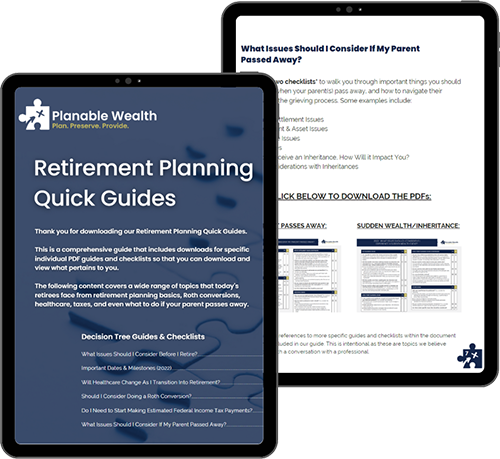
RETIREMENT PLANNING QUICK GUIDES [PDF]
Get instant access to several free PDF flowcharts and checklists that cover a wide range of topics that today's retirees face from retirement planning basics, Roth conversions, healthcare, taxes, and even what to do when your parent passes away.
"*" indicates required fields