Tax Season Blunders to Learn From and Avoid
If you're doing your own taxes or working with a tax preparer who doesn't specialize in wealth accumulation, financial planning and retirement, there's a good chance you're leaving thousands of dollars on the table every single year.
We’re talking four and five-figure mistakes that happen because nobody's looking at the details.
In this episode, Cameron walks you through six of the most expensive tax blunders he sees wealth accumulators and retirees make - from losing track of IRA basis to triggering Medicare surcharges you didn't see coming.
These aren't theoretical problems. These are real mistakes costing real people real money.
Learn about these potential issues before they arise so you don’t make the same mistakes!
More specifically, Cameron discusses:
- Losing Track of Form 8606 and Non-Deductible IRA Basis
- Estimated Tax Payment Disasters
- The IRMAA Time Bomb & Medicare Premium Surcharges
- Qualified Charitable Distribution (QCD) Mistakes
- Missing Cost Basis on Old Stock Positions & Paying More Taxes Than Necessary
- State Tax Exempt Interest and Dividend Mistakes
Resources From This Episode:
Retired-ish Newsletter Sign-Up
See if you’re a good fit for our Free Tax-Optimized Retirement Playbook™
Key Moments in The Episode:
(00:00) Tax Season Blunders to Learn From and Avoid
(05:33) 1. Losing Track of Form 8606 and Non-Deductible IRA Basis
(12:28) 2. Estimated Tax Payment Disasters
(18:10) 3. The IRMA Time Bomb
(22:56) 4. QCD Mistakes
(28:16) 5. Missing Cost Basis on Old Stock Positions
(32:30) 6. State Tax Exempt Interest and Dividend Mistakes
(41:14) Disclosures
If you're doing your own taxes or working with a tax preparer who doesn't specialize in wealth accumulation, financial planning, and retirement, there's a good chance you're leaving thousands of dollars on the table every single year. I'm talking four and five-figure mistakes that happen because nobody's looking at the details. I'm Cameron Valadez, and in this episode, I'm walking you through six of the most expensive tax blunders I see retirees make. From losing track of IRA basis to triggering Medicare surcharges you didn't see coming, these aren't theoretical problems. These are real mistakes costing real people real money.
00:01:07
Hello everyone, and welcome back to the Retired-ish Podcast. Today, I'm going to share with you tax season blunders that I've seen in practice as a certified financial planner and tax professional. Our firm reviews hundreds and hundreds of tax returns every year from clients and prospective clients to help make sure that they're utilizing every deduction and strategy that's available to them, provided by our tax code. We've seen some costly mistakes and mishaps along the way. Not only that, we're helping make sure that people report everything they're supposed to, so that one day the tax authorities don't come back and bite them with additional taxes and penalties, because nobody wants that. I want to share with you a few or several of these blunders we commonly see, so hopefully you don't make these same mistakes, and that way you can preserve more of your wealth each and every year.
Currently, the 2025 tax season is in full swing. The laws have changed once again since just last year, which will almost certainly bring its own set of confusion, errors, and amended tax returns. Regardless, we are still seeing these same mistakes or blunders over and over again that we've seen in previous years, regardless of these tax law changes. Some of these aren't small errors. A lot of these are four to five-figure mistakes that happen because people are either doing their own taxes and they're rushing and they're using these online DIY software that aren't necessarily going to catch everything, and they're relying on that software too heavily without understanding the nuances of the tax laws.
00:02:43
Or it could be because they're working with tax preparers who just don't specialize in retirement and wealth planning. And to be honest, a lot of times we're seeing it from professional tax preparation firms that have thousands upon thousands of clients. Sometimes these are those really giant firms that everybody knows and hears about on TV. And sometimes it's what looks like, you know, your local small business tax firm that's maybe located in your city where you live. But even some of these small businesses can have upwards of 1,000 to 2,000 plus clients. And usually, what you find when these firms are this large is that they're just churning and burning, right? The tax season is short enough as it is. They're just trying to get your information and get you back out the door and file a return, most of the time, when they have that many clients.
That's because they just don't have enough capacity, and they don't have enough bodies. They're not taking adequate enough time to dive deeper into your situation to see what's going on and to learn about what you're trying to do going forward in any type of tax planning or financial planning that you might have. They're just reporting whatever you give them, which sometimes they don't actually get all the information they're supposed to, and then they're just sending you back out the door without any recommendations or asking any questions.
And look, I'm not here to bash DIY tax software or professional preparers. I love my fellow tax professionals. And a lot of these tax software programs, where you do it yourself is very helpful, and we do need it. The reality is that there are different types of taxation specialties. Just like with doctors, there are general practitioners, there are oncologists, there are radiologists, so on and so forth. If your tax preparer doesn't work primarily with a variety of assets that clients might have, such as real estate, brokerage accounts, trusts, retirement accounts, and those people that are actually making moves every year because they do some sort of financial planning, they might not catch the small nuances in the tax code that can actually save you thousands.
00:05:00
So today, I'm walking through some of the most expensive tax blunders that I've seen people encounter recently, that are likely to be in similar situations to you. And I'm giving you these real-world scenarios so that you can see exactly how these mistakes happen and what they might cost. If you're managing IRA distributions, you're doing Roth conversions or rollovers, you're giving to charity, navigating an inheritance, or trying to optimize your tax situation near and in retirement, this episode could literally save you thousands. So let's get to it.
First up has to do with a tax form called Form 8606. This is a big one, and it has to do with losing track of your non-deductible IRA contributions. Now, not everybody is going to have this. This is primarily for those of you that utilize strategies such as the backdoor Roth IRA strategy. This strategy is used when your income is high and it's over the thresholds, in order to make a regular contribution to a Roth IRA. So instead of going through the front door to the party, you waltz through the back door that the IRS has left open for years. This is a completely legal and legitimate strategy that is fairly well known.
I want to help explain this by giving you a scenario. We have Bob, and back in 2008 through 2015, he was making good money, too much to deduct his traditional IRA contributions and get a tax break. So he made what we call non-deductible traditional IRA contributions totaling $25,000 over those years. He was supposed to file a tax form called Form 8606 each year to track that basis in his IRA. Maybe he did, maybe his tax preparer did, or maybe they didn't. Tracking the basis in your traditional IRA is very important because usually most of the money in a traditional IRA is all pre-tax. That's most people. Meaning when you put the money in, you get a tax deduction, and later, when you take the money out in retirement, you owe the taxes.
00:07:16
However, if you make a non-deductible contribution to a traditional IRA, that means you're not taking a tax deduction when you put the money in. So when you take that money out later in retirement, it should not be taxed. We definitely don't want to be double-taxed. So, in other words, you can have a mixture of different types of taxable dollars in your traditional IRA. Sometimes we in the industry will refer to this as the cream in the coffee.
So, anyway, back to Bob. Fast forward to the year 2025. He's 60 years old, and he takes a $100,000 distribution from his traditional IRA. Here's what should happen. That $25,000 that he already paid the taxes on and did a non-deductible contribution into his IRA, that's his basis. So only $75,000 of that $100,000 distribution should be taxable in 2025 when he took it out.
But here's the problem. When the IRS looks at your account, they don't see any Form 8606 on file for 2011 and 2013 in this example. Maybe they got lost in the mail. Maybe they were never filed. Maybe they were filed but not processed. It doesn't matter. If you can't prove that basis, the IRS treats it as zero. So you're now paying tax on the full $100,000, or Bob is, rather, even though he already paid tax on $25,000 of it. At a 22% federal tax bracket, that's an extra $5,500 in federal taxes, plus possible state tax on top of that. And good luck fighting the IRS on this without any documentation.
00:09:01
That was a relatively small amount in this example. Many high earners that utilize strategies like the backdoor Roth, they do it for many, many years. And so not tracking this properly can easily be a five-figure mistake later in retirement. And actually, there are two blunders that often come up with this backdoor Roth IRA strategy.
The second issue that we see quite a bit is when someone utilizes this strategy after you make the non-deductible contribution to the traditional IRA, you actually need to convert those dollars over to the Roth IRA. That's how you complete the strategy and get through that backdoor officially. And when that happens, it generates a tax form called a 1099-R for the traditional IRA, and it's going to show the amount that you converted over to the Roth as a distribution from your traditional IRA. Oftentimes, on these tax forms, it will say that the taxable amount cannot be determined. There is literally a little box that is usually marked on that 1099 that says that.
Again, the converted amount is not supposed to be taxed because it was a non-deductible contribution in the first place going into that IRA. And so sometimes when somebody does this, we'll see on a tax return that the amount that was converted over to the Roth IRA is put down as a taxable IRA distribution when it isn't. So let's say the maximum contribution was $7,000 for the year, and you decide to do this strategy. We will see $7,000 as a taxable IRA distribution that you're paying taxes on. That's the mistake. Actually, because it's being shown as a taxable distribution sometimes, these same individuals will definitely not have that Form 8606 filled out and filed showing any basis. Because if they had basis and they did the conversion, it wouldn't be showing up in the taxable line to begin with. Sometimes you get both of these mistakes happening at once, which is an absolute nightmare.
00:11:13
Here's the fix. Make sure that you understand the tax code around these strategies if you're doing your taxes on your own. Do your research. Now, if you're using a tax professional, don't assume that they know what this is and how to properly report it. Many don't because their typical clientele don't do these strategies. You need to let them know what you're doing earlier in the year and not just dump all of the information on them at tax time, especially if they have tons and tons of clients. Like I said earlier, if they do, they're just usually trying to get everybody's taxes done and out the door before tax day. You want them to be better prepared. If you're working with a financial advisor or planner that is helping you do things like Roth conversions, make sure that they are able to communicate with your tax professional. That way, these things get done correctly the first time.
Lastly, keep copies of every Form 8606 that you've ever filed. Keep them forever. If you made non-deductible contributions and you're not 100% certain those forms are on file with the IRS, you can request what is called your IRS transcripts now and verify that. Don't wait until you take a distribution later on down the road.
Okay, next up, let's talk about estimated tax payment disasters, especially with the late-year property sale or, again, Roth conversion mistakes that usually trigger these underpayment penalties. I'll give you an example. Here we have Linda. She's 53. And by the way, these are completely hypothetical names for these particular situations. We're not calling out anybody that we actually know. In late December of 2024, Linda decides to do a $50,000 Roth conversion. She figures she'll just pay the taxes owed from the conversion when she files her return in April of 2025.
00:13:10
This is what trips many people up. That $50,000 conversion is 2024 income, and the IRS treats that income as if it was earned all throughout the year in 2024, not just in December. So they also expect you to pay tax on that money throughout the entire year via either tax withholdings or estimated payments. If you don't make estimated payments or have additional tax withholdings, you will owe what are called underpayment penalties, which is essentially additional taxes.
So when you do a conversion in, let's say, the fourth quarter of any given year, which is very common when doing these conversions because you have a more accurate picture of your total income and tax situation towards the end of the year, and it helps you make a clear decision, you need to either, one, make a fourth quarter estimated tax payment by January 15th of the following year, or have tax withheld from the conversion itself, or have extra taxes withheld from one of your other income sources. So that could be your day job, it could be a pension, or even from a different IRA distribution. There are many different income sources where you can increase your withholding. So in this case, Linda does neither. She files her 2024 return in April of 2025 and owes about $11,000 in federal tax, assuming a 22% tax bracket. But she also owes underpayment penalties because she didn't meet what are called the safe harbor requirements, which is a little too in the weeds for this episode, so I won't really dive into that, but you can look into that if this sounds like your situation.
00:14:58
Those penalties might seem small depending on the size of the conversion, but they are completely avoidable. And if you're doing multiple conversions or large conversions, those penalties can add up really fast. Now, I just gave you one example, which was a Roth conversion, because, again, those are usually done towards the end of the year, and it's common when we see this issue with these types of conversions.
However, this can also pop up when you do something like a large distribution from a pre-tax IRA or a 401(k), and you don't withhold anything from that distribution. We've seen this happen when someone wants to make, let's say, a big purchase, like purchasing a house, and the only money they have is in pre-tax retirement accounts. They just want to bite the bullet and take a huge distribution from their retirement account to go make this purchase, and they say, "I'll worry about paying the taxes at tax time." It can also happen if you sell some sort of investment property, or maybe you sell some stocks, for example, at a very large gain towards the end of the year.
All of these situations create a large amount of income towards the end of the year, which, again, the IRS will treat it as if you earned it all throughout the year. So if you don't withhold from that giant pre-tax IRA or 401(k) distribution, then you're likely going to owe underpayment penalties. If you don't make an estimated payment after selling that property at a large gain, you're likely going to owe those underpayment penalties. So when you start to apply the underpayment penalty math to these situations where large amounts of income are involved, these penalties can get pretty big.
Here's the fix. When you recognize a lot of taxable income compared to the prior year, especially late in the year, make sure you have a plan to settle your tax bill timely. Again, the easiest way is to have some form of actual tax withholding because that withholding is treated as if it was paid evenly throughout the year. So it eliminates the underpayment penalty risk. And if you're not able to pay the taxes by additional withholding, then you'll need to figure out how and when to make an adequate estimated payment. And don't forget, if your state has an income tax, you'll also have to account for state income tax withholding or estimates as well.
00:17:25
One more little trick or fix that I will briefly touch on may help you save some money in underpayment penalties, but it may not help you get rid of the penalties completely. And that is when you go to file your return, and you fill out the underpayment penalty form, or your tax professional does, there will be an option to use what is called the annualized income installment method. It's basically an alternative way to calculate this underpayment penalty, and it is fairly complicated, so again, I won't get into the weeds, but I would definitely bring it up to your tax professional if you're in this situation. It can help reduce the penalty potentially, but usually does not end up wiping it out completely.
The third tax blunder that we commonly see, I call the IRMAA time bomb. And this one sneaks up on retirees out of sight, out of mind, and it can be brutal. Again, let me use an example to help explain this. Here we have Tom. He's age 71, and he's on Medicare. And his typical annual income is around $60,000 a year from Social Security and a small pension. In 2024, he opts to do a large Roth conversion to take advantage of his lower tax brackets. Therefore, Tom converts $120,000 from his traditional IRA to his Roth IRA. So he pays the tax bill when he files in 2025. Everything seems fine. Then, in late 2025 or early 2026, he gets a letter from Social Security that his Medicare Part B premiums are jumping significantly for 2026 because his 2024 income was so high.
00:19:12
Here's what many people don't realize. IRMAA, which stands for the Income Related Monthly Adjustment Amount, is a surcharge on your Medicare Part B and Part D premiums that is based on your income from two years prior. I know, leave it to the IRS to make the most complicated laws out there. I get it. It's kind of hard to follow. Again, just think of IRMAA as a fancy way of saying another tax. In this case, your 2024 income determines your 2026 Medicare premiums, and so on and so forth every two years.
These premium increases can be substantial. We're not talking about a few dollars. Depending on the IRMAA bracket you land in, and yes, there are different brackets, just like the tax brackets, and the higher your income is, the bigger the surcharges, you and your spouse could be paying thousands more per year in Medicare premiums. The most brutal part about IRMAA is that each bracket is a cliff. So once you go just $1 above each threshold, all of your premiums for the entire year are subject to that surcharge.
And this is where financial planning and retirement gets very important. There are cases where you can appeal these IRMAA surcharges if you had a life-changing event. Our firm does these all the time. So that could mean a retirement happened in the middle of the year, a divorce, death of a spouse, loss of income for whatever reason, changing jobs, losing a job, what have you. But "I did a big Roth conversion" or "decided to sell my vacation property or rental property at a gain this year" is not one of those qualifying events. That's a decision that you voluntarily made.
00:21:04
I will caveat that sometimes IRMAA is inescapable. For example, if you are fortunate enough to have a very large private pension or maybe even a government pension, and you're also getting things like Social Security, and maybe you have large retirement accounts where you're going to be taking required minimum distributions in your 70s, maybe you have income from rental properties or a business, whatever. If you have a lot of income in retirement, then IRMAA is going to be inescapable. It's just one of those things that you're going to have to deal with, which is unfortunate, unless you have a massive amount of tax deductions, which is unlikely at that time.
For those with more modest incomes, this issue can definitely squeeze your retirement income plan when you make certain decisions, such as Roth conversions, that might look good from an income tax perspective because it looks like you're taking advantage of low brackets or what have you, but on the other hand, it might cause these additional surcharges later, which can negate the benefit of making these decisions in the first place.
Here's the fix. Before doing any large Roth conversion or recognizing a ton of income from selling property or stocks, etc., calculate where that income puts you relative to these IRMAA brackets. Sometimes it makes sense to split conversions across multiple years in order to stay under those brackets. Sometimes it doesn't matter, and you are just going to convert anyway. Sometimes, depending on the math and what you're doing, it might make sense to recognize that income and go into maybe the first or second IRMAA bracket, knowing that you're only going to eat those additional surcharges for that one year. In any case, you need to know what you're getting into.
00:22:56
Moving on to tax blunder number four, QCD mistakes. So QCD stands for Qualified Charitable Distribution. These are one of the best tax strategies for retirees that are over age 70 and a half and are charitably inclined. But the timing is everything, and this gets screwed up constantly. So again, here's an example to walk you through it. We have Mary. She's 75, and she has roughly a million dollars in her IRA and has a $40,000 required minimum distribution for 2025. She is required to take $40,000 out of her IRA to spend or do whatever with, and she will pay the taxes on it. So in January 2025, she takes $40,000 from her IRA to satisfy her RMD and deposits it in her checking account. All good, right?
Then, in December of 2025, she's talking to her friend at church who mentions QCDs. Mary learns that she could have donated money directly from her IRA to her church tax-free. That is the benefit of doing a QCD. She thinks, "Great, I donate $20,000 to my church every year anyway." So in December of 2025, she does a $20,000 QCD from her IRA and sends it directly to the church. Here's the problem. She already satisfied her RMD with that January distribution of $40,000. The December distribution she took of $20,000 that she intended to be a QCD doesn't really count towards or reduce her 2025 RMD anymore. She can't retroactively designate which distribution she wanted to apply to her RMD.
00:24:50
So now Mary has $40,000 of taxable income from the January RMD, and she made a $20,000 charitable contribution from that same IRA that might not do much of anything for her tax-wise, even though it could have. Can't she deduct that $20,000 donation? Well, only if she itemizes now on her tax return. But between the standard deduction being around 30,000 to 35,000 for married couples in 2025 and even higher for those over 65, most retirees don't itemize. Mary is likely to get no tax benefit from that $20,000 donation.
On the flip side, if she had done the QCD first in January, that $20,000 would have been completely tax-free and counted toward her $40,000 RMD. She would have only needed to take an additional $20,000 in a taxable distribution to meet the total RMD of $40,000. So what's the difference? Well, she's paying tax on an extra $20,000 of income unnecessarily. At 22% federal rates plus 5% state, in her situation, that's about $7,000 in taxes she didn't need to pay. Or, since she will also have a required minimum distribution next year, she could have just waited until January and then done her annual gift to the church from her IRA in January, which would have offset her RMD for 2026.
Another common QCD mistake is taking the distribution from your IRA and putting it into your own bank account, then sending it over to the charity of choice. In order to have a qualified charitable distribution and get the benefits, the money needs to go directly from your IRA to the qualified charitable organization. And lastly, up until this tax year, QCDs were never reported on 1099-R tax forms. So if you did a QCD, you had to have proof of the amount that you sent directly to charity, and you had to indicate the taxable versus non-taxable amount of your IRA distributions on your tax return when you file it. And if you did a QCD early in the year and don't do your taxes until February or March of the following year, oftentimes you forget what was done, and you never told your tax preparer, then you might end up reporting the full distribution from your IRA as taxable when part of it was actually a QCD that shouldn't have been taxed. So make sure when you're filing your return, it's also being reported correctly.
00:27:38
Here's the fix. If you're taking an RMD from an IRA and doing some sort of charitable giving, do your QCDs first, earlier on in the year, then take any additional RMD amount you need after that. Don't wait until December to do all of your charitable contributions. The first dollars out of your IRA in any given year count towards your RMD. So once you've taken a regular distribution that satisfies your full RMD, any QCDs that you do later in that year won't offset that RMD because you've already met it.
Common tax blunder number five: missing cost basis on old stock positions. This one kills people with older brokerage accounts, especially if you've been reinvesting dividends from stocks for decades and have made a substantial amount of money over time. So again, we'll use an example to illustrate this. Meet Frank. He bought 500 shares of XYZ stock back in 1997 for $8,000. Now he's been reinvesting the dividends produced by that stock for about 30 years, meaning he's continuing to buy more shares of XYZ stock. In 2025, he decides to sell everything. So he gets $45,000 for his share. His 1099-B tax form from his investment custodian says, "Cost basis not reported to IRS," because these shares are from before the year 2011, when basis reporting requirements first started.
00:29:20
Frank uses an online DIY tax software, and the tax software asks for his cost basis, in other words, what he paid for the stock. So he enters $8,000 because that's what he paid for the stock originally. So that's correct, right? Wrong. Every time Frank reinvested those quarterly dividends over those near three decades, so about 120 times, those increased his cost basis in the shares. Those reinvested dividends were taxable income to him each year. He had already paid taxes on them. So when he sells the stock, part of the proceeds shouldn't be taxed again.
Frank's actual cost basis, when you account for all of those reinvested dividends, is probably around $26,000 or so in this example. And by only claiming $8,000 in basis, he's reporting a $37,000 capital gain instead of a $19,000 capital gain. And at 15% long-term capital gains tax rates, that's around $3,000 in unnecessary federal tax plus any potential state taxes. Again, if these numbers were larger, which they very easily could be, especially if you continue to invest diligently over a time period like three decades, the tax ramifications can be huge. The brokers don't track this for old positions, like I mentioned. Most DIY tax software will not catch it. And unless you kept every single dividend statement for 30 years, reconstructing that basis is nearly impossible, not to mention incredibly time-consuming. And this isn't just for stocks. This can happen with things like mutual funds as well.
00:31:09
Our firm helped an individual with this years ago that had a significant amount of gains in an old mutual fund position, and that mutual fund was causing high capital gains distributions every year that kept blowing up his desired tax strategy. So they wanted to sell the position in the mutual fund and reinvest it in something similar that didn't produce those capital gains distributions. The problem was when they looked at selling it, a significant portion of his basis was never reported to the IRS. So he had about 20-something years plus of basis reconstructing to do, which we helped with, and was able to strategically begin selling the mutual fund over time without paying too much in taxes.
So here's the fix in these situations. If you have old stock positions with reinvested dividends, work with a tax professional or an advisor to help reconstruct your basis before you pull the trigger and sell. Sometimes you can estimate based on the dividend history. Sometimes, the company, or what we call the transfer agent, may have records that you can go hunt down, and it's worth the effort for positions this old. And going forward, keep detailed records of all statements and dividend reinvestments, even though they should be reported to the IRS.
Rounding out our list of common tax blunders, we have state tax-exempt interest and dividend mistakes. This last one might be the most common one that we see each and every year, especially as of late, where over the past few years, interest rates had climbed to higher rates than we had seen for the past few decades. People are looking to take advantage of these higher interest rates with their cash savings or more conservative investments, especially when they use things like Treasury bills, notes, and bonds issued by the U.S. government. This is because the interest or dividends earned by obligations or bonds of the United States government and municipal bonds that you own in your own state of residence are not subject to state taxes. And that, of course, is if your state even has an income tax.
00:33:23
The issue is that we see the interest and dividends earned by these different types of securities reported as taxable income on state tax returns at least, I'd say, 10 times a year. You may say to yourself, "Hey, I don't own any of those things. I've never even heard of that. What is that? I've never bought a bond from the U.S. government. I don't have a Treasury bill." But you might own these things without realizing it. For example, many people will have cash in their brokerage accounts where they do their regular investing. And in those cash accounts, there may be interest that is earned from the U.S. government or dividends earned from the U.S. government. And again, over the last few years, the dividends and/or interest earned on your cash in these accounts has been pretty decent because interest rates have been higher. So many people have been hoarding their safety net cash or just extra cash they don't know what to do with in these accounts, rather than their bank accounts, because they're earning a lot more than the typical bank account.
A lot of times, these cash holdings are what are called money market mutual funds or government money market mutual funds. These funds are typically comprised of many short-term government debt securities like Treasury bills. Sometimes they're comprised of 100% Treasury securities, in which the interest and dividends generated by these money market funds are not supposed to be subject to tax on the state and local level. And while this is a very smart decision, if you live in a state that imposes high state income taxes, you may not actually be getting the benefit after all if it's not being reported correctly on your tax return. This is one of those things, as I said, that we see fly under the radar most of the time.
00:35:16
For example, Robert lives in California. He sold his successful business years ago. And while he invests a lot of that wealth, he has a lot of cash and what we call cash alternatives, such as money market mutual funds and T-bills, because he likes to do random bouts of gifting to his children, his grandchildren, and various charities throughout each and every year. He has a sizable amount of money in a money market mutual fund and some individual Treasury bills. Robert uses an online do-it-yourself tax software, and straight from his 1099 tax forms, he enters his interest earned from his Treasury bills and the dividends earned from his money market mutual fund, just as anybody would. The software pulls it to his federal return as taxable interest and dividends, which is correct. Then the software automatically auto-populates his California state return and includes those exact same amounts as taxable interest and dividends on that return as well.
This is the costly mistake for Robert. He doesn't even realize it's happening. For state tax purposes, interest and dividends directly from federal government obligations, such as Treasuries, are exempt from state tax. However, his software doesn't know how to delineate what interest and/or dividends are coming from a federal obligation. This requires manual adjustment. Robert is in California's 13% plus tax bracket. This income that's being included on his California return is being taxed at 13%, plus when it shouldn't be being taxed at all. Given Robert's level of wealth and the amount he set aside in Treasury bills and the money market mutual fund, he is paying five figures in taxes each year that should have never been paid. So think about the additional gifts to family and charity that could have been made with this money, but instead, it was gifted to the Franchise Tax Board of California.
00:37:21
So here's the fix. If you live in a state with income tax and you own securities that are obligations of the U.S. government, such as Treasury bills, bonds, notes, or these government money market mutual funds, or maybe you own municipal bonds or a municipal bond fund that are for your specific state, look at your 1099 tax forms very carefully. Many tax forms will delineate how much interest or dividends are coming from these types of securities. That way, you can go in and manually adjust it before filing your return and keep more of your own money in your pocket. Quite frankly, this is missed so often because many people rely on things like software and think that uploading a form is the end-all be-all and that the software will catch everything and do things correctly, when in fact, oftentimes they don't.
Those are six of the biggest tax blunders our firm has seen as of late, year after year. But this was certainly not an all-encompassing list. There's so much more. But in any case, let's recap. Number one: losing track of Form 8606 and non-deductible IRA basis. Remember, fill those forms out and keep them forever. Number two: not withholding or paying estimated tax when recognizing a lot of income later in the year, especially things like late-year Roth conversions and property sales. Number three: ignoring IRMAA, the income-related monthly adjustment amount, when making big financial decisions. Your Medicare premiums will spike two years later. Number four: QCD timing and reporting mistakes. Number five: missing cost basis from reinvested dividends on older stock positions. You may be overpaying on capital gains. Number six: not identifying and reporting state tax-exempt interest and dividends on your Treasury securities.
00:39:24
Every single one of these mistakes is avoidable. But first, you need to know they exist, and you need to either learn the rules yourself or work with a professional who specializes in financial planning, wealth accumulation, and retirement. If you're doing your own taxes, that's great. But just educate yourself on these issues and keep up with the ever-changing tax laws. If you're working with a tax preparer, ask them about these specific scenarios. If they look at you like you're speaking Greek, then you might need to find a different tax preparer.
As always, if you found this helpful, follow the podcast and share this with those who think like you and want to improve their financial outcomes. If you think you have a unique situation that requires this level of planning, feel free to reach out to our firm and schedule a discovery call for your own free retirement playbook at planablewealth.com.
If you haven't already, subscribe to and follow the show on your podcast app. That way, you can get notified each time a new episode drops. Also, be sure to check out our YouTube channel and sign up for our monthly newsletter to get more useful information on retirement planning, investments, and taxes once a month. The newsletter often dives deeper into some of the topics discussed on the show, as well as offers some useful guides and charts available for download. As always, you can find the links to the resources we have provided in the episode description right there on your podcast app, or you can head over to retiredishpodcast.com/87. Thanks for tuning in and following along. See you next time on Retired-ish.
00:41:14 Disclosures
The opinions voiced in this podcast are for general information only and are not intended to provide specific advice or recommendations for any individual. This information is not intended to be a substitute for specific individualized tax or legal advice. We suggest that you discuss your specific tax issues with a qualified tax or legal advisor. Cameron Valadez is a registered representative with and securities and advisory services are offered through LPL Financial, a registered investment advisor member, FINRA SIPC. Tax and accounting-related services are offered through Planet Business Services, DBA Planable Wealth. Planet Business Services is a separate legal entity and not affiliated with LPL Financial. LPL Financial does not offer tax advice or tax and accounting-related services. Traditional IRA account owners have considerations to make before performing a Roth IRA conversion. These primarily include income tax consequences on the converted amount in the year of conversion, withdrawal limitations from a Roth IRA, and income limitations for future contributions to a Roth IRA. In addition, if you are required to take an RMD, required minimum distribution, in the year you convert, you must do so before converting to a Roth IRA.
The opinions voiced in this podcast are for general information only and are not intended to provide specific advice or recommendations for any individual.
This information is not intended to be a substitute for specific individualized tax or legal advice. We suggest that you discuss your specific tax issues with a qualified tax or legal advisor.
Cameron Valadez is a registered representative with, and securities and advisory services are offered through LPL Financial, a Registered Investment Advisor, Member FINRA/SIPC.
Tax and accounting related services offered through Plan-It Business Services DBA Planable Wealth. Plan-It Business Services is a separate legal entity and not affiliated with LPL Financial. LPL Financial does not offer tax advice or tax and accounting related services.
Traditional IRA account owners have considerations to make before performing a Roth IRA conversion. These primarily include income tax consequences on the converted amount in the year of conversion, withdrawal limitations from a Roth IRA, and income limitations for future contributions to a Roth IRA. In addition, if you are required to take a required minimum distribution (RMD) in the year you convert, you must do so before converting to a Roth IRA.
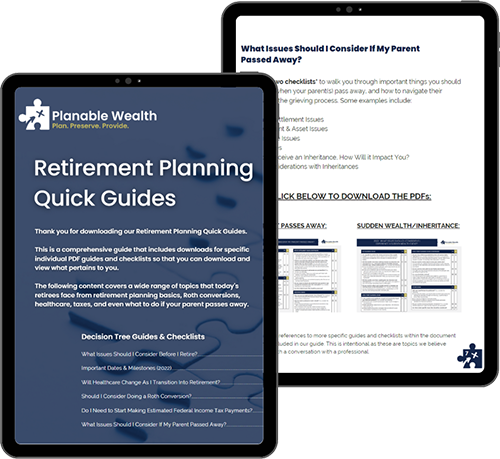
Get your free
RETIREMENT PLANNING QUICK GUIDES [PDF]
Get instant access to several free PDF flowcharts and checklists that cover a wide range of topics that today's retirees face from retirement planning basics, Roth conversions, healthcare, taxes, and even what to do when your parent passes away.
"*" indicates required fields