Strategies To Reduce Estate Taxes for High-Net-Worth Individuals
If you think estate taxes are only a problem for billionaires and celebrities, I've got news for you:
A couple in their 50s with a combined few million in retirement accounts, a paid-off home, maybe a rental property, and 20 + years of compounding ahead of them? Their beneficiaries could easily be looking at a 40% + federal estate tax bill when they die.
However, there are legitimate, legal strategies to dramatically reduce or even eliminate these taxes. Some of them are as simple as how you spend your money today. Others involve sophisticated trust structures that can save your family hundreds of thousands, if not millions in taxes.
In this episode of Retired-ish, Cameron pulls back the curtain on estate tax reduction strategies that high-net-worth retirees utilize to preserve their wealth and pass it on efficiently.
More specifically, Cameron discusses:
- What are gift and estate taxes? And how much are they?
- Who is subject to gift and estate taxes?
- Should you try and avoid gift and estate taxes or capital gains taxes?
- Stocks and real estate in irrevocable trusts
- Power of Substitution to swap assets between irrevocable trusts and your estate
- Retirement accounts and estate taxes
- Other strategies to reduce gift and estate taxes
Resources From This Episode:
Downloadable PDF: Common Types of Trusts
Retired-ish Newsletter Sign-Up
See if you’re a good fit for our Free Tax-Optimized Retirement Playbook™
Key Moments in The Episode:
(00:00) Understanding Estate Taxes
(04:00) Who Needs Estate Planning?
(08:19) Gift & Estate Taxes vs. Capital Gains Taxes
(10:41) Irrevocable Trusts: Real Estate & Stocks
(17:00) Advanced Asset “Substitution” or “Swap” Strategy
(20:29) Retirement Accounts & Estate Tax
(25:00) The Smart Spending Strategy
(30:42) Sophisticated Estate Planning Tools to Reduce Estate Tax Exposure
(36:26) Final Thoughts & Resources
If you think estate taxes are only a problem for billionaires and celebrities, I've got news for you. You see, a couple in their 50s with a combined few million in retirement accounts, a paid-off home, maybe a rental property, and 20-plus years of compounding ahead of them, their beneficiaries could easily be looking at a 40%-plus federal estate tax bill when they die.
However, there are legitimate, legal strategies to dramatically reduce or even eliminate these taxes. Some of them are as simple as how you spend your money today. Others involve very sophisticated trust structures, but they can save your family hundreds of thousands, if not millions, in taxes. On today's episode of Retired-ish, I pull back the curtain on estate tax reduction strategies that high-net-worth retirees utilize to preserve their wealth and pass it on efficiently.
00:01:22
Hey, everyone. Cameron here with another episode of Retired-ish. Today, we're diving into something that, at least statistically speaking, affects a relatively small percentage of the population. But that percentage has been growing significantly over the past decade or so. And we're talking about estate tax reduction strategies for high-net-worth individuals and families.
Estate taxes are essentially a death tax, where your money will be subject to a tax rate that is paid by your estate when you pass. Therefore, more money comes out of the inheritance for your heirs. You may also be taxed on your money while you're alive if you gift it to others, and you have a high enough net worth and end up gifting more than the estate tax exemption during your lifetime. So these taxes can actually apply while you're alive. And if they don't apply while you're alive, they might apply at your death.
00:02:21
When it comes to being subject to these federal, estate, and gift taxes, as of 2026, we're only talking about those individuals and families that have estates, so the total net worth, essentially, that will be valued at $15 million or more. And again, that is just the figure for 2026. These laws can and do change. If you're married, that can essentially double to $30 million, again, at least under current law. Now, that's just the federal law. When it comes to the individual states and where you reside, they have different thresholds for their own estate taxes, some as low as $1 million. And there are also many states that don't have an estate tax, or what people like to call a death tax.
Now, one thing I want to clear up, because it confuses a lot of people, is the fact that these estate and gift taxes are completely separate from the typical income taxes that you're used to paying when you file your taxes every April. The estate and gift taxes can easily deteriorate much of the wealth you have worked so hard to build for your heirs and your family because the rates are high. Currently, the federal estate tax rate is a whopping 40%. And again, that is just the federal estate tax rate. You may have state estate taxes or, and rather, there are income taxes that might be owed on certain types of assets that you might pass down to your heirs on top of this federal estate tax. But we'll talk a little bit more about that later.
00:04:00
So that being said, if you end up being subject to estate taxes, whether federally or via your state of residence, it's going to be really important to know how to reduce these taxes as much as possible, which requires significant planning while you're alive. That's the key part. And because we never get to know what day will be our last, if you think you will be in this situation in the future, because maybe you're not worth $15 million today, or you could possibly be in this situation right now, you need to start this planning today. And even if you have started this planning, you need to keep up on it and update it year in and year out because these laws do change.
I know you're thinking, wow, I'm nowhere close to $15 million or $30 million combined with my spouse, so I don't have to worry about this. But it's not all about what you're worth today. I would be careful there, very careful. If you have a few million dollars in net worth today or liquid assets, and you live another 20 to 30 years, and you get 20 to 30 more years of investment compounding, and these federal thresholds change, you could easily have an estate tax problem at some point in your life. Just because they're $15 or $30 million now doesn't mean they're always going to go up or they can't change. In fact, this year, in 2026, if the new tax bill was not passed, they were actually going to go back down to about $6 or $7 million. So you need to pay attention to this moving forward. And please realize that this is not just for celebrities and billionaires.
For instance, you could be someone who diligently saved for retirement with a decently high-paying job in a 30-year career. You might have $2 million, let's say, in your 401(k), own a home, and maybe a rental property or two. And then maybe you inherit a little bit of money from your parents when you're in your 50s or 60s. And that situation right there could put you in possible estate tax territory 20 years down the road or sooner, depending on future legislation, and of course, depending on how much you've saved and if you do inherit any money, how much you inherit.
00:06:14
So here's the reality. The number of multi-millionaires in this country has been climbing rapidly over the past couple of decades. We've had one of the best bull runs in history in the stock markets, the explosion of equity, or so-called stock compensation, from big tech companies and some other industries. There's been a lot of successful business exits, people selling businesses. We've got a ton of real estate appreciation over the past 5 to 10 years, larger and larger inheritances, also because of all these things. And yet, just the compounding effect of diligent saving and investing, more people are starting to put money away and save as these private pensions from the companies they work for are slowly going to the wayside. All of this has created more liquid personal wealth than ever before.
What was an uncommon problem a generation ago is becoming increasingly common. The people that fit this profile aren't just the tech executives everybody thinks of. Although, yeah, if you've been stacking restricted stock units and stock options at a large publicly traded company for the last decade, you might be there. But maybe you work in a rather blue-collar job, but are fortunate enough to have had an employee stock ownership plan for maybe several decades. Or again, you inherited something like the family business, and you continue to run it until you get the opportunity to have an exit that's worthwhile. That payday, in and of itself, will now cause you to start planning for gift and estate taxes.
00:07:57
Maybe you're a surgeon or some other professional specialist who's just been diligently maxing out retirement accounts and maybe building real estate holdings for 30 years. The point is, this isn't just about the celebrities, the big executives, and the tech entrepreneurs. This is about anyone who's accumulating significant wealth and wants to pass it on efficiently.
OK, so now that we know how important this is, let me start with something fundamental that most advisors gloss over because it's kind of complicated and it doesn't fit on a pretty pie chart. When you're doing estate planning at this level, you're not just thinking about possible estate tax and how to avoid it. You should also be thinking about the interplay between estate taxes and other forms of taxation. More specifically, as an example, capital gains taxes.
Now, here's a simplified way to think about all of this. Federal estate taxes are assessed on the value of your estate that exceeds the exemption threshold when you die. In 2026, like I said before, that's $15 million per person or $30 million for a married couple. Amounts over that exemption are effectively taxed at 40%, which is the federal level. Again, generally speaking, the gift taxation works very similarly. If throughout your lifetime you have gifted over and above the same shared exemption amount, that same $15 or $30 million, then those dollars that you continue to gift beyond that are also taxed at 40%, but they're taxed while you're alive. You will pay the tax, not your estate at your death.
Capital gains taxes, on the other hand, which are between 0% and 20%, are assessed on appreciation when assets are sold at a gain. Here's the kicker. When you die, most capital assets, other than things like retirement accounts and annuities, get a step-up in basis as long as they were includable in your estate.
00:10:06
That means your heirs can sell appreciated assets basically immediately and effectively pay zero capital gains tax. So you've got this weird math problem. Is it better to pay a 40% estate tax on an asset that gives your heirs a stepped-up basis? Or is it better to get the asset out of your estate, which will help avoid the 40% estate tax, but give up that step-up in basis that would subject your heirs to capital gains taxes? The answer isn't one size fits all. And this is where planning can get a little messy.
For instance, let's talk about one of the common things we see, which is real estate and stocks that are put in irrevocable trusts, because this is where I see the most room for error, so to speak, or mistakes. Let's say you put a high-value investment property into an irrevocable trust to get it out of your estate. Again, that's why you would use an irrevocable trust generally, is because it removes an asset from your taxable estate. And just for reference, many people will have seen or have heard or have what we call a revocable living trust or a family trust. And anything that's titled in those types of trusts will generally be part of your estate. So they're different.
Any taxes that are generated from those types of trusts while you're alive, you are responsible for paying as you go. So those are also included in your estate. And the assets inside would generally still be subject to potential estate tax. Now, with many irrevocable trusts, you're making an irrevocable gift to a separate trust that is not attached to you anymore, so to speak.
00:11:57
And it will generally not be included in your estate, or the assets titled in that trust will not be in your estate. This generally allows you to help avoid estate taxes on the assets in that irrevocable trust. However, in return, you often give up access to the assets or the money that you put in there and the use of the money while you're alive, unless you use a little more sophisticated planning, which we will touch on later.
So, OK, great. You've got the property in an irrevocable trust and potentially saved 40% in estate taxes federally on that property's future value. But now that rental income is being generated and taxed at trust tax rates until you die or you get rid of the property, because the income that it's generating stays in the trust and doesn't flow to you personally. Trust tax rates for ordinary income hit the highest bracket at something like $16,000 of income starting in 2026, which is not much. Again, we're talking roughly 40% in taxes on ordinary income generated within the trust. So this isn't an estate tax. This is just a regular income tax like you and I pay. However, trusts and estates have their own income tax rates.
If most of your return on that real estate is from the cash flow and not so much from the appreciation, which is the case for many types of investment properties, you just traded a one-time 40% estate tax hit for an annual 40% income tax hit, which essentially reduces the ability for the returns to compound sufficiently over time. That's not necessarily a win, especially if you're planning to hold that property for 20 or 30 years.
00:13:59
Now, if your personal income is, let's say, $1 million a year or more, and you're already paying 40-plus percent in personal income taxes on most of your income already, then it may make sense to place it in an irrevocable trust to try and avoid the estate taxes later because it might be a wash whether you hold it personally or in the irrevocable trust for income tax purposes while you're alive.
On the other hand, if you've got highly appreciating assets or assets that have a great potential to grow significantly, so think growth stocks and tech company shares, concentrated stock positions, etc., the math typically changes. These types of assets might throw off very minimal dividends or maybe none at all, so they're not really producing a lot of income actively, but they might have massive appreciation potential. So in an irrevocable trust, the capital gains rate maxes out at 20%, just like the personal rates, plus you'll have the 3.8% net investment income tax likely. So call it roughly 24% at the federal level. And that is much lower than the 40% estate tax rate.
So theoretically speaking, in this case, if, let's say, you had a concentrated highly appreciating stock position or a portfolio of highly appreciating stocks, and they're held in an irrevocable trust, your heirs would not get a step-up in basis on those shares at your death, meaning they would owe capital gains taxes on any of the growth from those stocks if they decided to sell. But again, they would be subject to the lower capital gains rates. If you were to keep those highly appreciating stocks or the portfolio in your estate and not in the irrevocable trust, then they would get a step-up in basis, which would eliminate most, if all, of the capital gains. However, they would owe the 40% in federal estate taxes.
00:16:11
So to help make sense of that, again, if you had highly appreciating stock that does not produce a lot of taxable income year in and year out, and you put that in that irrevocable trust, it's not going to matter that the trust has very high ordinary income tax rates because it's not really producing a lot of income. They're just appreciating shares. Basically, you're not paying too much in taxes while you're alive on those assets in the trust.
However, when you pass, they will be removed from your estate, so you will not pay the 40% in estate taxes, or your estate won't pay that. But your heirs will pay the capital gains. However, the capital gains, as we established federally, are only going to be about 24%. So there's a significant savings there of about 16%.
With advanced language in structuring of these trusts, there's a sophisticated move that may be available to you that almost nobody talks about. So again, if your trust is structured properly, you can actually swap assets in and out of irrevocable trusts under certain circumstances. Let's go through this using a hypothetical example. Let's say you put $1 million of XYZ stock into an irrevocable trust 10 years ago, and now it's worth $5 million. So that $4 million of appreciation is sitting in the trust still.
You could swap that appreciated stock position for $5 million of cash or some other asset from your personal holdings that are not yet in that irrevocable trust. And then you can bring that appreciated XYZ stock back into your estate out of the irrevocable trust.
00:18:01
And when you die, your heirs will get a step-up in basis on that $4 million of gain and save nearly $1 million in federal taxes alone. Meanwhile, the $5 million of cash or replacement securities you put into the irrevocable trust they have a high basis. Cash has a high basis because cash doesn't appreciate.
So there's very little, if any, capital gains tax consequences there when you pass. You've essentially preserved the step-up in basis benefit while still keeping assets out of your estate. Initially, you had $5 million worth of stock in an irrevocable trust after the appreciation. If you were to pass away, your heirs would inherit it, not pay estate tax on it because it's in that irrevocable trust, but they would pay capital gains taxes on it. The $5 million you had in personal assets or cash that was in your estate would have been subject to the 40% estate tax.
So in this case, you pay capital gains taxes on the $4 million of growth of the stock, and you pay 40% in estate taxes on the $5 million you had in your estate in cash or whatever other asset. But when you utilize this swap strategy in this hypothetical example, at least, all we're doing is shifting the two in different pockets, so to speak. When we put the $5 million in cash in the irrevocable trust, that now has a basis of $5 million. And if you were to pass away, there is no estate tax since it's out of your estate and it's in the irrevocable trust.
And there's essentially no capital gains taxes owed because there's no growth on it, like I said. Then the securities that you swapped out that are now a part of your estate, those get the step-up in basis when you pass ,all the way up to the $5 million. And so your heirs, if they wanted to, could sell it and not pay much, if any, capital gains tax.
00:19:59
However, yes, they would be subject to estate tax on the value of that stock. In this case, you're only paying the estate tax on $5 million, no capital gains on the other $4 million.
Now, of course, this is pretty advanced stuff, and you definitely need proper legal documentation and advice to do it right. But it's a perfect example of how the estate tax versus capital gains tax analysis isn't static.
OK, let's switch it up a little bit and look at what we can do about retirement accounts when trying to reduce estate and gift taxes. So let me give you a real situation my firm has run into in the past. Jack, we'll call him, wasn't his real name, built a successful consulting business, and he sold it a few years ago. And after the sale and including his other assets, he was sitting on about $40 million in net worth. Now, a good chunk of that, about $8 million, I believe it was, was in pre-tax retirement accounts. So think 401(k), IRA, SEP IRA, cash balance plans, etc.
Here's what's interesting about retirement accounts in the estate tax context. When Jack dies, that $8 million, let's just say it's in an IRA, is going to be included in his taxable estate. But his beneficiaries are also going to owe income taxes on the distributions that they eventually take from that retirement account once it's put into an inherited IRA in their own name. So you've got this nasty sort of double taxation problem, which is estate tax on the value of the IRA at death, then income tax on the distributions when the beneficiary takes it out. Ouch. So we ran the numbers, and depending on his children's tax brackets, they could be looking at a combined federal tax bite of anywhere between 60% and 80% on that IRA money.
00:22:05
So that's estate taxes plus income tax. It's brutal. Now, technically, you're not supposed to pay both of these taxes, but many people do inadvertently, which is why I'm discussing it. Even many tax professionals miss this little quirk in the system.
When federal estate taxes are paid on something like an IRA, the amount of estate taxes that the IRA caused and were paid can actually become what is called an income in respect of a decedent deduction, or IRD deduction for short. That deduction can then offset the distributions that the beneficiary makes later and is normally subject to income taxes on. So this helps reduce or eliminate this double taxation. However, like I said, this is often missed, surprisingly. By the way, it only applies to federal tax law. So if your state imposes a state-level estate tax, then you and your heirs may very well have double taxation on some of that IRA money.
Now, for a situation like Jack's, we can also consider Roth conversion strategies if his heirs will likely be in higher tax brackets than him or if he or you were to live in a state with its own estate taxes. And the reason this can potentially save a significant amount in state-level estate taxes is because when you do a Roth conversion, you either pay the taxes owed from the Roth account itself or you pay the tax from other assets that you have, maybe cash in the bank, whatever. Either way, the money you use to pay the taxes on the Roth conversion today will leave your estate because you won't have it anymore.
00:24:03
So you can run into situations where the thresholds for the states on these estate taxes are often much lower. Let's just say, as a hypothetical example, your estate has a $1 million estate tax exemption, meaning everything above the $1 million is subject to estate taxes at your death. And let's say that your estate is worth $1.4 million and you're on your last leg and most of your net worth is in pre-tax retirement accounts. Well, you're able to do a large Roth conversion and potentially get your estate back under $1 million in net worth and avoid being subject to any estate taxes, plus leave your heirs with a tax-free asset.
This is the kind of analysis that requires running actual numbers for your specific situation, but it's why things like Roth conversions can make sense even when they seem counterintuitive.
Now, let's talk about the spending strategy that nobody talks about. And this is something that drives me kind of crazy. People tie themselves in knots trying to optimize gifting strategies and using their, what we call, annual exclusions, and they completely miss the most obvious strategy to try and reduce gift and estate taxes, which is... just spend the damn money.
If you want to reduce your estate, spend money on things that benefit your family, let's say, because if you spend the money for them, you're not gifting them the money. So it doesn't count towards your exemption of the $15 million or the $30 million if you're married. So maybe pay for a big family vacation every year. That's not necessarily a gift, depending on how you do that. It's you spending your own money on something you enjoy that happens to include your kids and your grandkids or whoever.
00:26:00
It's out of your estate. Nobody owes taxes on it, and it doesn't use up any of that annual exclusion or lifetime exemption. You can pay for your grandkids' education directly to the institution that they go to. Tuition paid directly to an educational institution doesn't count as a gift for gift tax purposes. You can write a check for $60,000 to Stanford for your granddaughter's tuition if you want, and it's not a taxable gift. It doesn't use up your annual exclusion, doesn't use your lifetime exemption, just reduces your estate by $60,000. Same thing with medical expenses that you pay directly to the medical provider. Your son or grandson needs surgery and doesn't have great insurance. Okay, pay the hospital directly, not a taxable gift.
And by the way, just to give you some more context here about these annual exclusions that I'm talking about and gift taxes, I forgot to mention earlier, as of 2026, there is an annual gift exclusion of $19,000 per spouse per year. And that applies to each individual that a gift is given to. So, for example, a married couple can have an exemption of $19,000 each for a total of $38,000 that they can give to any one individual in a given year, and that will not eat into their $30 million exemption. It won't reduce it. They can just give them cash if they wanted to up to those amounts and not worry about losing part of their lifetime estate and gift tax exemption.
So circling around back to what I just mentioned, if you directly pay for medical care or education on behalf of somebody else, that doesn't have that $19,000 per year cap. So you can give an infinite amount of money essentially by paying directly for those things.
00:27:57
Now, if instead you gift the person, let's say it's your child or grandchild, the cash, and then they pay for it, well, yes, now you just gave a gift and it's subject to that $19,000 per year cap to be fully excluded and not affect you. If you give them more than that, then the amount that you go over is just going to eat into your lifetime exemption. So it'll start to eat away at that $15 million or $30 million.
People also underutilize 529 college savings plans in this estate planning context. 529 contributions, they do count as gifts that are subject to gift taxes. The cool thing is you're allowed to accelerate up to five years' worth of that annual exclusion at once when contributing. So currently, that's $95,000, which is $19,000 times five, and that is per beneficiary and from just one individual. So if you're a married couple, you can essentially double that.
But here's the thing with that. You would be funding education expenses that you might not even be around to see because generally when you're funding these 529s, you're funding them when the beneficiary, the child or the grandchild, let's say, is fairly young. Right? And you do that because the money in those accounts can grow tax-deferred and tax-free when used later, when they're older and needing the money for their education. So your grandkid might not go to college for another 15 years. So you're effectively pre-spending money that has the ability to now grow tax-free when used later for education expenses, and it will benefit your family without estate tax consequences when you die. Since after you gifted the money while you were alive, you have now removed it from your estate, and you have also removed the future growth of that money from your estate.
00:30:00
So again, if you were to gift, let's say, $95,000 and it sat in one of those accounts for 15 years and it grew to $200,000, you just saved that money out of your estate because if you held onto the money and invested it yourself, you would have had the growth, and then when you passed, there could have been estate taxes owed on that growth.
The point is, if you like helping your family and spending quality time with them, and you enjoy experiences, just do it. Just pay for it. Direct spending is the most efficient estate reduction strategy because there's zero tax on it, no reporting requirements, and no complexity.
Now let's talk about some of the more sophisticated techniques. And I'm going to touch on these pretty briefly because each one really deserves its own episode and deep dive, but I just want to go over them so you know that they exist.
And the first one is family LLCs. These are entities where you consolidate family assets and then gift an interest in those assets to, let's say, your children over time. And the key benefit here is what we call valuation discounts. If you gift your kid 20% of a family LLC that holds, let's say, $10 million in assets, that interest may not be worth $2 million for gift tax purposes. And again, $2 million is 20% of the $10 million. It might be worth, let's say, $1.4 million or less because there could be a lack of control and a lack of marketability discount. You're moving assets out of your estate at a discount, which can be very powerful if you have a very large estate. And these definitely require the guidance of a skilled attorney and well-drafted entity documents.
00:31:58
Next, we have irrevocable life insurance trusts. These are a little more common than something like a family LLC. They're also called ILITs for short. These are one of the most utilized tools, I would say, for people with estate tax problems because the concept is you create an irrevocable trust. The trust owns a life insurance policy on your life, and when you die, the death benefit pays out to that trust tax-free because the trust owns the policy and it's irrevocable. That death benefit is not included in your taxable estate, like we talked about earlier, because it's in that irrevocable trust.
On the other hand, if you just own a life insurance policy and you pass, yes, your beneficiary will receive the death benefit income tax-free, but it will still count as part of your estate. And if you are subject to estate taxes, then they will owe those estate taxes on your life insurance proceeds. So hypothetically speaking, if you and your spouse have, let's say, a $33 million estate, and you're going to owe estate tax on $3 million of it, the amount that's over the exemption, that's $1.2 million in estate tax. You could fund an ILIT with a $2 million life insurance policy, let's say, pay the premiums over your lifetime, and when you die, that $2 million death benefit pays the estate tax and maybe leaves extra for the kids all outside of your estate. The catch is that you can't control these trusts. It has to be truly irrevocable, and you need to use annual exclusion gifts like we talked about earlier, and that's usually via what we call crummy powers to make the premium payments. But for the right situation, ILITs are phenomenal.
Then we have grantor retained annuity trusts, or GRATs for short. And these can be a great technique or vehicle for people with appreciating assets. Here's how they generally work.
00:34:00
A GRAT is an irrevocable trust where you transfer appreciating assets, and you receive a fixed annuity payment back for a set term or fixed annuity payments. So typically between like two and ten years. And any assets remaining after all of the annuity payments go to your beneficiaries, gift tax-free.
The IRS assumes a certain rate of return on the assets that are in the GRAT. They call it the 7520 rate, a.k.a. the hurdle rate. So if your assets appreciate faster over and above that rate, the excess appreciation passes to your kids with no gift tax. The risk is you have to outlive the GRAT term. And if the assets don't outperform the 7520 rate, that hurdle rate, nothing passes to your kids. But if you've got concentrated stock positions or other high-growth assets, GRATs can be incredibly efficient. They essentially lock in the current value of the asset for estate tax purposes, and any future potential growth goes to the beneficiaries. Plus, you're able to receive income while you're alive for a stated period, which is always nice.
Then, for those who are charitably inclined, we have the donor-advised fund, or DAF for short. These are another tool that are commonly used for those that, like I said, are charitably inclined. Here's how they work in a nutshell. You get an immediate tax deduction when you contribute money to the DAF. The money grows tax-free, and then you can direct grants to different charities over time. The money is out of your estate immediately, and you get the income tax benefit now, when it might be more valuable, and you're accomplishing your charitable goals.
00:35:58
Plus, if you donate appreciated stock, let's say, to a donor-advised fund, you avoid the capital gains tax on the appreciation, but you still get a deduction on your tax return for the full fair market value of the stock. So these can be a very powerful tool if used correctly because they can give you tax benefits today, and they can also help with the estate tax problem at death.
Here's the bottom line. Sophisticated estate planning requires extensive preparation. It requires assumptions, calculations, and proper documentation. But I think these examples and strategies that I went over today are a perfect example of how estate planning at this level isn't just set it and forget it. It's not the same as, "Hey, I went and got my family trust done and I funded it, and now I'm good." This is especially the case if you have a high net worth that is maybe already at these thresholds or 20 to 30 years from now could be at these thresholds. And I would say, even if you're not super close or you don't think you'll be there, you still might run into this issue later because the laws can change and these thresholds can come down significantly. You never know. And so you need to actively manage your estate plan as asset values change and the tax laws evolve.
The point is, if you're in estate tax territory, you do have options. You actually have a lot of options. And we covered a bunch today, like Roth conversions, strategic spending, ILITs, GRATs, charitable giving, those swap strategies, but we're barely scratching the surface. There's a lot more out there. And so if you think you have a unique situation that requires this level of planning, feel free to reach out to our firm and schedule a discovery call for your own free retirement playbook at plannablewealth.com. Through that playbook, if you have some of these issues or you might in the future, we will definitely address them and some of the options that you'll have.
00:38:00
If you haven't already, subscribe to and follow the show on your podcast app. That way, you can get notified each time a new episode drops, which is every two weeks on Monday. Also, be sure to check out our YouTube channel and sign up for our monthly newsletter to get more useful information on things like retirement planning, investments, and taxes, estate planning once a month. The newsletter dives deeper into some of the topics discussed on the show, as well as provides some useful guides and charts available for download. As always, you can find links to the resources we have provided in the episode description right there on your podcast app, or you can head over to retiredishpodcast.com/86. Thanks again for tuning in and following along. See you next time on Retired-ish.
00:39:09 Disclosures
The opinions voiced in this podcast are for general information only and are not intended to provide specific advice or recommendations for any individual. This information is not intended to be a substitute for specific individualized tax or legal advice. We suggest that you discuss your specific tax issues with a qualified tax or legal advisor. Cameron Valadez is a registered representative with, and securities and advisory services are offered through LPL Financial, a Registered Investment Advisor, Member FINRA/SIPC. Tax and accounting-related services offered through Plan-It Business Services DBA Planable Wealth. Plan-It Business Services is a separate legal entity and not affiliated with LPL Financial. LPL Financial does not offer tax advice or tax and accounting-related services.
The opinions voiced in this podcast are for general information only and are not intended to provide specific advice or recommendations for any individual.
This information is not intended to be a substitute for specific individualized tax or legal advice. We suggest that you discuss your specific tax issues with a qualified tax or legal advisor.
Cameron Valadez is a registered representative with, and securities and advisory services are offered through LPL Financial, a Registered Investment Advisor, Member FINRA/SIPC.
Tax and accounting related services offered through Plan-It Business Services DBA Planable Wealth. Plan-It Business Services is a separate legal entity and not affiliated with LPL Financial. LPL Financial does not offer tax advice or tax and accounting related services.
Traditional IRA account owners have considerations to make before performing a Roth IRA conversion. These primarily include income tax consequences on the converted amount in the year of conversion, withdrawal limitations from a Roth IRA, and income limitations for future contributions to a Roth IRA. In addition, if you are required to take a required minimum distribution (RMD) in the year you convert, you must do so before converting to a Roth IRA.
Fixed annuities are long-term investment vehicles designed for retirement purposes. Gains from tax-deferred investments are taxable as ordinary income upon withdrawal. Guarantees are based on the claims paying ability of the issuing company. Withdrawals made prior to age 59 ½ are subject to a 10% IRS penalty tax and surrender charges may apply.
Get your free
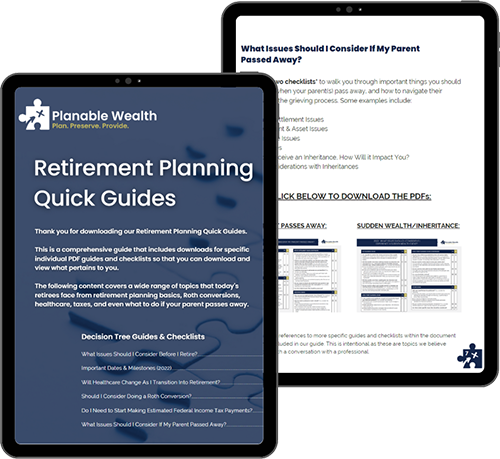
RETIREMENT PLANNING QUICK GUIDES [PDF]
Get instant access to several free PDF flowcharts and checklists that cover a wide range of topics that today's retirees face from retirement planning basics, Roth conversions, healthcare, taxes, and even what to do when your parent passes away.
"*" indicates required fields