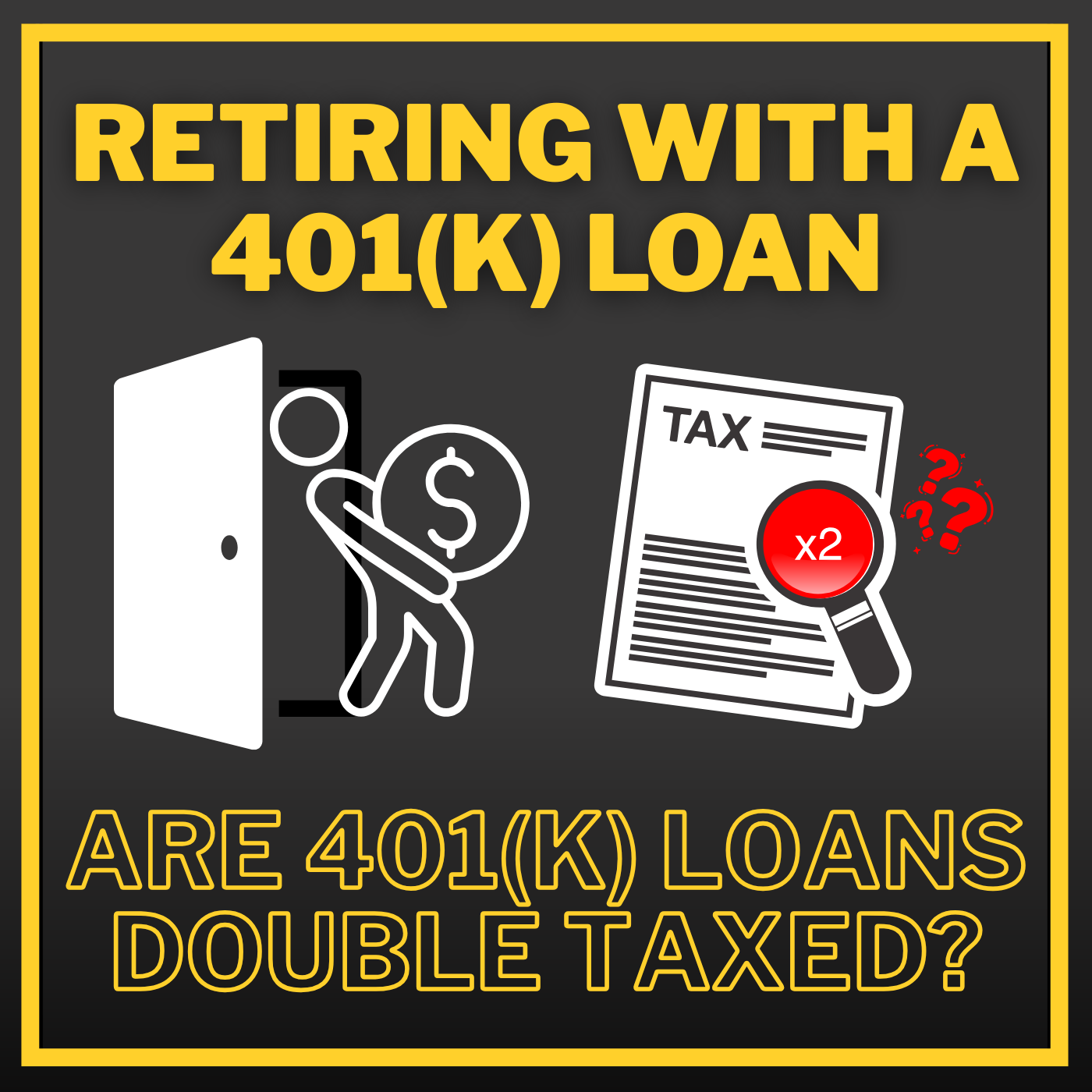
I Want to Retire But I Have a 401(k) Loan & Are 401(k) Loans Double Taxed?
If you're planning to retire in the next year or two and you have a 401(k) loan, this episode could save you thousands of dollars in taxes.
I've seen too many people walk into retirement with an outstanding loan balance and get blindsided by a massive tax bill they could have easily avoided with a little planning.
Then we're going to tackle one of the biggest myths in the retirement world - the idea that 401(k) loans are double taxed. Spoiler alert: they're not, and even very influential financial gurus get this wrong.
More specifically, Cameron discusses:
- The requirements for a tax-free loan from an employer plan such as a 401(k)
- The tax ramifications of a “Deemed Distribution”
- The tax ramifications of a “Qualified Plan Loan Offset” or QPLO
- Potential tax pitfalls when retiring with an outstanding plan loan balance
- Are 401(k) loans double taxed?
Resources From This Episode:
Retired-ish Newsletter Sign-Up
See if you’re a good fit for our Free Tax-Optimized Retirement Playbook™
Key Moments in The Episode:
(00:00) 401(k) Loans and Retirement
(02:12) Requirements for Tax-Free 401(k) Loans
(06:33) "Deemed Distributions" Explained
(11:03) "Qualified Plan Loan Offsets" and Rollovers
(15:43) Retirement Tax Planning & ACA Subsidies
(19:28) Case Study: ACA Subsidies at Risk with Outstanding 401(k) Loan Balance
(27:01) Alternatives for 401(k) Loan Repayment
(30:20) Debunking the Double Taxation Myth of 401(k) Loans
(39:51) True Costs of 401(k) Loans
If you're planning to retire in the next year or two and you have a 401(k) loan, this episode could save you thousands of dollars in taxes. I've seen too many people walk into retirement with an outstanding loan balance and get blindsided by a massive tax bill that they could have easily avoided with just a little planning. Then we're going to tackle one of the biggest myths in the retirement world, the idea that 401(k) loans are double-taxed. Spoiler alert. They're not. And even very influential financial gurus get this wrong. So let's go.
Welcome to Retired-ish, a podcast for folks who are retired or approaching retirement and want the truth about what really matters when it comes to their money. I'm your host, Cameron Valadez, Certified Financial Planner and Enrolled Agent. Today's episode is all about 401(k) loans, specifically what happens when you're trying to retire, but you still have one of those floating around out there. This is way more common than you'd think, and the tax consequences can be brutal if you don't plan ahead.
So we're going to walk through the various rules and pitfalls to watch out for, and I'll show you an example of how this can blow up your retirement tax strategy, especially if you're retiring early, meaning before age 65 and eligible for Medicare, and counting on those Affordable Care Act subsidies for health insurance. Then we'll debunk the persistent myth that 401(k) loans are double-taxed using some examples.
[00:01:55]
It seems more and more individuals are heading into retirement or planning their retirement within the next year or so, but they have an outstanding loan still hanging around from their 401(k), which may or may not be an issue, but it can be especially tax-wise depending on your exact situation.
I don't blame anybody because 401(k) loans, they're pretty easy to get. The interest rates can be lower than rates that a bank would charge you. They sound enticing because the interest you pay, you technically pay back to yourself. The loan application process is pretty simple. You don't need a credit check, and most plans allow loans for any reason at all, and they provide immediate access to retirement funds at any time, even if you're under age 59 and a half. With many Americans having their retirement plan as their biggest asset, other than maybe their home, it's just an easy spot to get money when needed if your particular employer plan allows for them.
Plan loans can be made from 401(k) plans, 403(b) plans, which are common with teachers. It's sort of a sister plan to a 401(k) in a way, and even governmental plans, which are 457 plans. They cannot be made from IRAs, which include the simple IRA plans and a SEP IRA plan as well. And the amount borrowed from a 401(k) plan plus the interest is paid back to your own account. Plan loans are not subject to tax or penalties if all of the tax code requirements are satisfied, which we're going to discuss at length because this, in my opinion, is the biggest factor when trying to retire with an outstanding plan loan. I know you probably don't want to know all the detailed ins and outs of the potential tax ramifications, but my goal is to explain this to you and break it down in an easy-to-understand way in case you're trying to do your own retirement planning.
[00:03:57]
I want to help you prevent making these expensive mistakes. And of course, if you don't want to deal with any of this, I would strongly consider hiring a professional that's competent in this area.
Before we get into the tax nuances, we first need to understand what the requirements are for a tax-free plan loan. Most loans are going to check these boxes, but I think it's important to know just in case. There are a few requirements that need to be met for a tax-free loan from a plan. The first is that the loan terms need to be legally enforceable, meaning they need to be put into an agreement. And this is usually satisfied because there is a promissory note and an amortization schedule that's typically made by the third-party administrator or your employer when you go to get the loan.
Number two, the loan cannot exceed a maximum amount. There are rules for this as far as how much you can take from your 401(k) plan. You can't just take a loan for whatever amount you want. And the rule is that loans are limited to the lesser of 50% of your vested account balance or $50,000. For example, if you have a vested 401(k) balance of $500,000, the maximum loan you can take is $50,000 because that is the lesser of $50,000 or half of your vested balance.
Half of your vested balance would be $250,000.
However, if you have a vested 401(k) balance of $75,000, then the maximum loan you can take is $35,000. There are some exceptions to this rule, but for simplicity's sake and from trying to save us from going down a deep rabbit hole, we're going to save those for another time because they're fairly rare and they detract from the important pieces of the episode.
Number three, the third requirement is that the loan has to be amortized by equal installment payments, and they can't be made any less frequently than quarterly. Again, this box is typically checked off automatically for most people, because you pay your loan repayments back through your payroll, which is typically on a more frequent basis than quarterly.
[00:06:07]
Number four is that the loan can't exceed a certain time period. So generally, plan loans have to be amortized and paid back over five years. However, there is an exception for a longer payment period, and that is for loans used to acquire a primary residence. Most plans will limit these residential loans, let's call them, to 10 or 15-year payoffs.
All right, now that we know the requirements, let's get into these tax nuances of 401(k) loans. Then we can look at a case study on why not having at least a basic understanding of these tax implications can potentially cost you thousands. There are two primary terms to be familiar with if you're going to retire soon or are separating service from your employer and have an existing 401(k) plan loan balance. And these two terms are one, deemed distributions, and two, plan loan offsets.
A deemed distribution happens when you fail to satisfy one of those four requirements that we just discussed. Deemed distributions aren't incredibly common, but they can and do happen. I've seen it many times in my career, typically when someone misses a loan payment. That's usually when we see that happen. But it's not the only way or the only reason a deemed distribution can happen. A deemed distribution makes your loan or part of your loan taxable. But here's the most important part here. The loan stays on the books of the retirement plan, so you still have to repay it.
If a deemed distribution occurs, you're going to have some taxation in that year regardless. So you're going to pay taxes. And you're still going to have to pay that loan back.
[00:07:56]
The amount that is taxable to you, it could be the entire original loan amount, it can be an amount by which your loan exceeds the maximum limit that's allowed if you have an outstanding loan balance beyond that limit, or it could be the current outstanding loan balance, whatever it is. And usually this is the case if, let's say, you missed a repayment. So that loan that was supposed to be tax-free that you now have in your bank account, or maybe you've already spent it on something that now becomes fully taxable or partially taxable, depending upon what requirement was not met and how. And the kicker here is that if you're under age 59 and a half while employed, or you're under age 55 after you separate from service, and you have a deemed distribution that's taxable, it's also likely that you're going to be subject to the 10% early withdrawal penalty in addition to the regular taxation.
Another complication here is the fact that you get taxed on a particular loan balance, but then still have to pay back the outstanding loan balance. What this means is essentially you pay tax on that loan once it's a deemed distribution, and now you're having to put it back in the retirement plan, and then later on in retirement, when you take that money back out, you're going to be taxed again, at least theoretically. But actually, to the extent that you repay a loan balance after you've been taxed on it from a deemed distribution, the principal portion of the repayments go into your plan as what is called after-tax basis. And this means they should not be taxed again when you take the money out later in retirement, even though you're putting it back in a pre-tax retirement account. That's why that term after-tax basis is important. The interest you pay back, however, will be taxed when taken later, since you didn't get the interest portion when you originally took the loan.
[00:9:58]
The potential issue here is that this basis will need to be very meticulously tracked going forward so that you don't pay tax twice on this money on accident. And that's usually not done for you by the investment custodian. It might be, but usually the onus is on you to keep track of that. So, in short, try to avoid running into a situation where you will have a deemed distribution.
Pretty simple, right?
Okay, now let's talk about the prettier sister of the deemed distribution, which is called the plan loan offset. If your employer's plan allows, for what is called plan loan offsets, not all of them actually need to allow this, then your account balance can be instead automatically offset by the amount of any unpaid loan balance in order to repay the outstanding loan. Then you are taxed on that offset amount. However, you get an opportunity to defer the tax, which I will get into in a second. A loan offset can happen upon some sort of triggering event that causes the loan amount to become due.
These triggering events would be defined in your employer's specific plan document. So the document that has all the rules about your 401(k) plan, which you should have a copy of. And if you don't, when you're nearing retirement, I would probably ask HR for one and definitely read it or at least give a copy to your professional advisor. And it's usually called the plan document, literally for the 401(k) plan. Retiring, termination/separation from service, is usually one of those triggers, sometimes the only trigger other than death or disability. And of course, we don't want to have to use those triggers, right? A loan offset does not result in a violation of one of the requirements we talked about earlier, like a deemed distribution does.
[00:12:00]
Instead, it occurs when a plan loan becomes immediately due under plan rules. For instance, when you retire and terminate employment. So I know you might be confused about the difference and how this works. So here's an example.
You have a fully vested pre-tax account balance of 650,000 in your 401(k), and you have an outstanding loan of $30,000. You leave your employer, and your plan allows for loan offsets upon termination. This means that you have the option to roll over your funds to an IRA if you'd like, or possibly roll it to a solo 401(k) if you operate a little small business in retirement or a side hustle, we like to call them. But you'd only get to roll over 620,000. The other 30,000 offsets your IOU, so to speak. And so far, you are going to be taxed on that 30,000. But the main difference here is you also now don't need to pay it back. Again. They will take 30,000 out of your balance, and that will take care of your IOU. The loan offset amount is not paid to you, but it is taxable to you, at least initially, and possibly subject to an early withdrawal penalty. Again, if you withdraw it and you're ineligible to, get that penalty waived like we talked about earlier, so it's taxable to you in the year the offset occurs, unless, and this is one of the big benefits of loan offsets, unless you can come up with the funds to roll it over.
In layman's terms, this means you would have to come up with the cash to replace that loan offset amount. So the funds for the rollover must come out of pocket; in other words, you can't roll over funds from another IRA that you might have in order to satisfy this. It's got to be cash contributed, not a transfer from another pre-tax account.
[00:14:01]
The deadline to get this rollover done is your tax filing due date, including extensions for the year in which your offset occurs. The IRS has said that an offset amount can be rolled over, AKA replaced, as late as six months beyond the normal tax return due date. In other words, as late as the following October 15th, normally, if you don't roll money into the plan by that deadline, the loan amount is taxable in the year of the offset. But again, big difference between this and the deemed distribution. You don't have to pay back the money. You're just going to owe the tax. So essentially, with the loan offset, you kind of get the option, right? You can pay the money back. And then not have any taxation, or you can just accept taxation and not put the money back. Makes sense?
Of course, this means that if you successfully complete the rollover, you won't be taxed in the current year. However, that money will still eventually be taxed once you take it out or your beneficiaries take it out in the future. Again, that money goes back into that pre-tax account, and it works like it was supposed to from the beginning. And again, just to simplify this, when I say rollover in this context, you're just making a cash contribution equal to the loan offset amount to the IRA. If you were to roll the funds to an IRA, you're not “paying back” the loan. The loan is already gone. You're just replacing the distributed funds with new money to avoid taxation of that outstanding loan amount in the current year.
How do you make sure that you don't get taxed if you followed all these rules correctly? Well, these different custodians, wherever your accounts are held, they are supposed to issue certain tax forms, 1099s, and these have special codes on them. And there's another form when you contribute money called a 5498, and that has special codes on it. And these codes need to basically match up, and they tell the IRS essentially a story about what you've done.
[00:16:10]
Here's another hypothetical example. We have Katie. She's 60 years old. She currently has 1. 2 million in her 401(k) plan. She borrowed $30,000 from her 401(k) plan two years ago in 2024. In 2026, Katie decides to retire, and she has an outstanding loan balance of 23,000. Under her plan specific terms, the loan becomes immediately due at separation from service and is offset. So she decides to roll the balance, which is now $1,177,000, which is the 1.2 million minus her outstanding loan of 23,000 to an IRA.
Let's look at her deadline to try and prevent this loan from being taxable by utilizing that qualified plan loan offset provision that allows for a rollover. Katie has until October 15th of 2027 to come up with all or some of the money of the $23,000 to roll over into her IRA, even if she does not officially extend her 2026 tax return deadline.
Now, why 2027? Because she retires in 2026, the loan is immediately offset. So 2026 is the year of the offset. If Katie does not complete a rollover by October 15th of 2027, meaning she does not come up with any of that 23,000 in cash and replace it to make herself whole, she will have $23,000 of additional taxable income. And since she is over age 59 and a half in this example, she would not have to worry about any 10% early withdrawal penalty.
[00:18:00]
Okay. So now that you have somewhat of an understanding of what the potential ramifications are, here's why this stuff becomes really important when you're approaching retirement with an outstanding loan balance in your 401(k) or similar plan. When you retire, your income may change dramatically depending on your available income sources, such as Social Security, pensions, retirement portfolio withdrawals, rental income, annuities, etc.
In addition, your tax situation will almost definitely change as well. You won't have certain pre-tax deductions that you used to have that came out of your paychecks while you were working. You will be forced to incur taxable income in your 70s because you'll have to start taking required minimum distributions from your pre-tax retirement accounts. You may have new deductions and credits and lose others, especially once you reach age 65. And you'll eventually experience new, what I call, shadow taxes, that will come into play once you start taking Social Security and become eligible for Medicare. And heck, you may even inherit some assets from your parents, which throws another wrench in your playbook. Let's just say taxes in retirement will be a bit of a different story than they were while you were working, and they will continue to change at different age milestones. That being said, whether or not and when you recognize income from a 401(k) plan loan can drastically affect the taxes that you pay in that first year of retirement.
So let's go through one hypothetical example where, due to the additional taxation from a 401(k) loan, someone can lose certain valuable tax credits. And again, this is just one example.
There's a whole plethora I could go through, where we've actually seen this happen to people, and they come to us for help.
[00:20:01]
Here's our example. We have Corey and Rochelle. Corey has already retired, and he is age 58. And Rochelle is dead set on retiring after the first of the year in 2026 at the young age of 57, so her and Corey can enjoy an active retirement playing golf and pickleball while they're still able to. Rochelle has amassed a good-sized retirement nest egg to the tune of 1.4 million in her 401(k) plan, but she has an outstanding loan balance of $25,000.
So, Corey and Michelle they've been diligent savers. They are also very frugal, and therefore, their house is already paid off. They have no other debts other than Rochelle's plan loan, and they have relatively little expenses that they expect to have in retirement. Their only income in retirement will come from their own retirement savings in each of their 401(k) plans and IRAs, etc. And they also will eventually apply for Social Security. They expect they can live comfortably on around $6,500 a month before taxes.
However, the biggest issue for them is going to be health insurance coverage. One of the potential cons of retiring before age 65 is that you are not yet Medicare eligible, and therefore, under current law, you basically need to fill that gap with health insurance that you purchase on the federal marketplace or your state's specific marketplace if they have one. And this, of course, is if your former employer does not offer any kind of retiree health coverage. And of course, your spouse is no longer employed, and they don't have health coverage either. They are fairly healthy, Rochelle and Corey, so they plan to shop for what we call a silver level plan, which offers somewhat lower premiums than the higher tier plans, those gold and platinum plans. And it has a little bit bigger of a deductible.
[00:22:00]
And because they are healthy, that is a risk they are willing to take in order to save money on their monthly premiums.
Now, if you aren't familiar, health insurance through the Affordable Care Act or the marketplace can actually be very expensive depending on your situation. And under the current law, this is being recorded towards the end of 2025. There is a tax credit called the Premium Tax Credit that you can qualify for. Now, the amount of the credit depends on your income as well as the cost of the plan from the marketplace that you select. If you qualify for the credit, it essentially gets paid to you in the form of subsidies or discounts on your premiums. So, in other words, instead of getting a tax credit at the end of the year when you file your taxes, you just get a discount every month on your premium that you pay for your insurance. The potential issue here is that the rules around eligibility for this credit are set to change dramatically in 2026, unless Congress acts sooner.
We are still unsure of what exactly is going to happen, but if nothing changes, it is already in the law that there will now be an income cliff, we like to call it, where once you have $1 beyond 400% of the federal poverty line for your household size, you no longer qualify for any of the subsidies, so none of the credit. So you can go over by $1 and lose the whole thing, meaning you will pay the full amount for insurance with no subsidies.
This differs from the current rules because, as of right now, in 2025, even if you earn over 400% of the federal poverty line, there's still an ability for most people to get some sort of credit or subsidy. Now, in Corey and Rochelle's situation, qualifying for this credit can be extremely impactful on their tax bill and the longevity of their retirement savings.
[00:24:02]
Because if they don't qualify for it, obviously, their $6,500 a month need for their living expenses is going to go a heck of a lot higher because their health insurance is going to get really expensive. So they look into the silver plans, and they realize that the full cost is around nineteen hundred dollars a month or twenty-three thousand dollars per year, which is absolute sticker shocker for the two of them. Of course, this would definitely impact their finances, and they don't like the fact that they would have to pay so much money for something that they may not use.
However, if they are able to stay under the 400% of the federal poverty level threshold in 2026, they should be eligible for that premium tax credit and pay only around $700 a month, which they still might think is kind of high if their employer was paying for it before, but it's a lot lower compared to $1,900 a month. Dramatic difference. So under current law, they could cut their healthcare premiums down to around $8,400 a year compared to $23,000 per year until they become Medicare eligible. Which, of course, as you can tell, equates to tens of thousands of dollars in savings.
Now that we understand that this tax credit or subsidy in this scenario is going to be extremely important to them, what is Rochelle's 401(k) loan, or what does Rochelle's 401(k) loan have anything to do with this? Well, the issue is she wants to retire right after the beginning of the year. If she separates from service, her plan allows for that loan offset. Meaning her account balance will be offset by the $23,000. But she will also recognize $25,000 of taxable income in 2026. If this happens, the $25,000 combined with their income need of around $80,000 a year will put them over the threshold for qualifying for the credit.
[00:26:05]
Because if the current law stays in place as it is right now. Then, eligibility for the credit is lost if their income is $1 over 400% of the poverty line in 2026. And just so you know, the poverty line, 400% of the poverty line for a household of two, according to your tax return, is, I believe, around 86,000. So they're going to be well over that number.
Therefore, if Rochelle is going to retire before paying this loan off, it's going to be crucial that her and Cory have $25,000 set aside somewhere in order to complete a qualified plan loan offset using that rollover like we discussed earlier. This will allow them to defer the taxation of that $25,000 over the rest of their lifetime and spread it out over multiple years as they take money out instead of recognizing that whole lump sum in one year, causing them to lose this valuable credit. However, there are many people who may not have $25,000 in cash set aside over and above their emergency fund. So in these cases, your options might be a little more limited.
Now, if Rochelle was over age 59 and a half, depending on her plan document, she might have another alternative to this. If they didn't have this kind of cash just lying around, it wouldn't be as beneficial as the rollover for the plan offset, but. It may help her and Corey qualify for the credit in 2026.
If you're over 59 and a half, many plans allow for something called an in-service distribution. It's basically a withdrawal that you can take from your 401(k) plan without having to prove some sort of hardship. And when you take the money out, it is taxable in the year that it is taken. And some plans they allow you to take one of these in-service distributions without having to pay off any outstanding loan balance first.
[00:28:07]
So what she could do if her plan allowed for it and she was over age 59 and a half in 2025, she could take a withdrawal that gives her $25,000 net of taxes and then take that $25,000 and pay the loan off. Therefore, she would not recognize the extra income next year in 2026 and potentially lose eligibility for the credit. This would, of course, cause her to recognize even more income in 2025 while she's working, which would have its own tax ramifications, especially if she makes a lot of money.
But those tax ramifications would need to be compared to the financial and tax ramifications of losing the credit in the following year in retirement. So it depends on a lot of things. How expensive is the healthcare plan that you're buying? What's the credit you would expect to receive if you were eligible? Again, how much income are you earning in 2025? And is that extra 25,000 gonna cause some significant damage? These things need to be compared.
Again, this wouldn't be the absolute best way to go about it. It's not really my favorite way, but it is an option that can still help them accomplish their goal and save some money. And the cost of this move would likely be far less than the savings in health insurance premiums in 2026 in their situation.
This is just one of many quirky situations, as I said, that can happen going into retirement with a 401(k) loan. But everyone's situation will be fairly unique as far as their income prior to retirement, their expected income need in retirement, what are they going to be withdrawing from portfolios, or where is their income going to come from? What is the amount of their income in retirement? What does their taxable income look like in retirement? Right? So what kind of deductions and credits might they be getting?
[00:30:00]
The size of the loan balance that you have, their age, etc. Lots of different things are going to make this unique for everybody.
The point is that if you're not going to pay the loan off before you retire, then it behooves you to sit down and do some in-depth financial and tax planning.
All right. While we're on the topic of 401(k) plans and loans, I want to talk about the very common misconception out there that 401(k) loans are double-taxed compared to other types of loans or withdrawals. They are not. The principle nor the interest is double taxed. And the reason so many people get confused by this, even many, many professionals, is because the question is often thought about and framed incorrectly from the start. The question isn't anything about or shouldn't be anything about being double-taxed. It's really about the fact that the interest that is paid back on a 401(k) loan is not tax-deductible. I'm going to warn you now, you can go down a serious rabbit hole for hours and hours looking through blogs, articles, and input from financial gurus online, or arguing with your large language model like ChatGPT or Claude, Gemini, whatever. They will mostly say that it's all double-taxed, or at least the interest is. Those are kind of the two competing ideas out there, but I'm here to tell you that neither part of the loan is double-taxed. Said differently, you are not causing double taxation of your money by taking a loan from your 401(k). But that also doesn't mean taking 401(k) loans is highly encouraged. That's a totally different story. We're just talking about the taxation here if you were to take a loan.
So this double taxation is a huge, huge myth. And many sources on the Internet, including highly influential people such as Susie Orman, for example, will say that the principal you pay back is not double taxed, but the interest is. And again, I can't say it enough. Neither the principal nor the interest gets taxed twice because you took a loan from your 401(k).
[00:32:06]
So you're probably wondering, why do I say anything different than most people on the internet? Well, let me explain. When you borrow, say, $10,000 from your 401(k), you're not receiving taxable income. You're temporarily removing money that's already yours, and the loan amount you received was never taxed because it came from pre-tax contributions in earnings. So I'm talking about a loan from a pre-tax account here because that's normally where people are taking the loans from. When you repay the loan principal with after-tax dollars, you're simply returning money to your account, using new earnings that you earn from work that would have been taxed anyway. You're not being taxed twice on the same dollars because it's a 401(k) loan. You're being taxed once on the new money that you earned to repay the loan, which is normal income taxation. Then you're paying income taxes when you later withdraw that paid back principal portion in retirement.
Think of it this way. If you had $10,000 in your pre-tax 401(k), you'd pay taxes on it when you took it out in retirement. But let's say instead of taking a loan from your 401(k) today to go buy a car for $10,000, you go to the bank, and you get a loan to buy the car. You'd still have to earn income, pay taxes on it, and have $10,000 left over, plus interest net of taxes to pay the loan back to the bank. In this case, you are paying taxes on the earnings that you used to pay the bank back. And you're still paying taxes when you take out your money in retirement, the money that you did not get a loan from in your 401(k). Right. So it works the exact same way. The interest argument is a little more subtle, but the conclusion is the same. No double taxation occurs.
[00:34:03]
So let's go through some examples to break this one down and simplify it, because this is where it gets a little more confusing. And just a heads up for these examples, we will assume a 25% federal tax rate. And we're not going to include state taxes just to keep the math simple here. But of course, they would come into play if your state had state income taxes.
All right, scenario number one, you have a 401(k) loan, your starting position is you have a 401(k) balance of $10,000, and you borrow that $10,000. I know you're not allowed to technically borrow all of it, and we have those limits unless there's an exception. Again, we're just keeping the math simple here. Just imagine you're borrowing the entire amount.
So you borrow the $10,000 to buy a car. What happens? You borrow $10,000 from the plan, you buy the car, no tax event, right? You took a loan. However, your ten thousand dollars is not earning any interest from the Investments in the 401(k) plan anymore since you took it out. So over one year, you earn by going to work fourteen thousand dollars total before taxes to repay the loan that has a five percent interest rate. So you pay three thousand five hundred dollars in income tax on that fourteen thousand dollars of earnings, which is 25%, then you use the $10,500 that's left after tax to repay your loan. So again, instead of it being 10,000, it's 10,500 because there was 5% interest around 500 bucks.
Now your 401(k) balance is back to $10,500. Eventually, in retirement, you're going to withdraw $10,500, and you're going to pay $2,625 in tax. Again, we're assuming you have the same tax rate of 25%.
[00:35:57]
So what are the total taxes that were paid? Remember, we paid $3,500 in taxes on the 14,000 that we just earned by going to work. And then we paid the 2,625 in retirement when we took out $10,500. So our total is $6,125 in taxes.
Now let's look at scenario B. In this scenario, there is no loan, and the 401(k) in this instance, to make this apples to apples, the investments inside it are going to earn the same rate of return as was the interest rate in scenario A, and that was 5%. So the investments, we're just going to assume they make 5% in the 401(k).
So, your starting position again, you have a 401(k) balance of $10,000. You need to buy a $10,000 car. What happens again? Assuming a 25% federal tax rate, you need to earn 13,333, pay 3,333 in tax, which is 25%. Then you buy the car with the 10,000 you have left after taxes. Now, over that same one-year period, you are going to earn 667 from working, probably a lot more, and you're going to pay 25% on that, which is $167 in tax, leaving you with $500 after taxes. Now, your 401(k), because it's going to earn 5% in this hypothetical, it grows from $10,000 to $10,500 over that next year. Again, because the investments are earning 5% and your money's in there because you didn't take a loan.
Eventually, in retirement, you're going to withdraw that $10,500, just like in the last scenario, and you're going to pay $2,625 in tax, same amount. So now let's look at the total taxes paid. We have $3,333, and that is the taxes that were owed on the $13,333 we earned from working.
[00:38:04]
Then we have another $167, which again, was just us earning another $667 and paying 25% in taxes. And then we also take the withdrawal out in retirement, same amount, 10,500. We pay 25% and the total is $6,125 in total taxes. So if you didn't pick this up yet, that is the exact same amount as scenario A, the total taxes are identical. It's $6,125 in both scenarios, 401(k) loan or not. In both cases, you earn $14,000 total. So in scenario B, it was a little tricky, but when you add the 13,333 to the 667, that gets you 14,000. Your 401(k) ends up at $10,500, and you pay the same total tax.
The 401(k) loan does not create any additional taxation that didn't already exist. It merely changes the timing and the path of how you earn and deploy income. It's just a change in cash flow. The interest you pay yourself on the loan, in our example, the $500, it replaces the investment growth that your 401(k) would have earned anyway, assuming this rate of return was the same or similar to your interest rate. That $500 can come from paying yourself back in interest, or it can come from investment returns, to which you'll owe 25% in tax in this scenario when you withdraw in retirement. There is no double tax on the interest, just the normal income tax on withdrawal.
The actual costs that you should care about with 401(k) loans are one, the opportunity cost. So the borrowed amount isn't invested, so you miss potential investment gains above the loan interest rate.
[00:40:01]
For example, if your interest rate for your loan is 6% and you could have, would have, should have earned an average of 9% in your 401(k) portfolio over the duration of that loan payoff, that would have been a missed opportunity. So again, yeah, there is definitely a potential cost there, but it just depends on the rates and, of course, the rate of return that you get, which you're not really going to know ahead of time. We don't get to predict the future like that. So in our scenario, we had to keep it apples to apples. And keep them the same to explain the concept. But yeah, there is a real cost if you miss out on certain earnings in your 401(k) plan.
The second cost is repayment pressure. So if you leave your job, the loan may be due almost immediately. And we already talked about that, and that can end up costing you a heck of a lot of money depending on your situation.
A third cost is reduced contributions. Not everyone, but most borrowers, when they take a loan from their 401(k), they reduce or stop their normal 401(k) contributions while they're repaying that loan. And of course, that has a cost because it slows down your retirement savings and your goal.
Number four is there is the risk that you default on the loan, and again, we talked about that earlier. Unpaid loans become taxable distributions, and you might even have a 10% penalty to boot.
Hopefully, that squashes the double taxation myth for you. Be careful acting on information you find on the internet or AI chatbots, especially, which get their information from the internet, and they do a little thing called hallucinating, where they are just completely incorrect. That includes this podcast, too, of course. I'm not telling you to believe everything that we say here, but always reach out to your own chosen professional for advice when you're actually going to act and take action. What's that saying? It ain't what you don't know that gets you in trouble. It's what you know for sure that just ain't so something like that. There are so many examples of that in the financial and tax world.
[00:42:04]
Anyways, if you haven't already, subscribe to and follow the show on your podcast app. That way, you can get notified each time a new episode drops every two weeks. Also, be sure to check out our YouTube channel and sign up for our monthly newsletter to get more useful information on retirement planning, investments, and taxes once a month.
The newsletter often dives deeper into some of the topics we discuss on the show,as well as useful guides and charts available for download. As always, you can find the links and the resources we have provided in the episode description right there on your podcast app, or you can head over to retiredishpodcast.com/84. Until next time, thanks for tuning in and following along. See you next time on Retired-ish.
[00:43:07] Disclosures
The opinions voiced in this podcast are for general information only and are not intended to provide specific advice or recommendations for any individual.
This information is not intended to be a substitute for specific individualized tax or legal advice. We suggest that you discuss your specific tax issues with a qualified tax or legal advisor.
Cameron Valadez is a registered representative with, and securities and advisory services are offered through LPL Financial, a Registered Investment Advisor, Member FINRA/SIPC.
Tax and accounting-related services offered through Plan-It Business Services DBA Planable Wealth. Plan-It Business Services is a separate legal entity and not affiliated with LPL Financial. LPL Financial does not offer tax advice or tax and accounting-related services.
Investing involves risk, including the potential loss of principal. No investment strategy can guarantee a profit or protect against loss. Past performance is not a guarantee of future results.
This is a hypothetical example and is not representative of any specific investment. Your results may vary.
The opinions voiced in this podcast are for general information only and are not intended to provide specific advice or recommendations for any individual.
Hypotheticals used are examples and are not representative of any specific investment. Your results may vary.
This information is not intended to be a substitute for specific individualized tax or legal advice. We suggest that you discuss your specific tax issues with a qualified tax or legal advisor.
Investing involves risk, including the potential loss of principle. No investment strategy can guarantee a profit or protect against loss. Past performance is not a guarantee of future results.
Get your free
RETIREMENT PLANNING QUICK GUIDES [PDF]
Get instant access to several free PDF flowcharts and checklists that cover a wide range of topics that today's retirees face from retirement planning basics, Roth conversions, healthcare, taxes, and even what to do when your parent passes away.
"*" indicates required fields