Frequently Asked Tax Questions During Divorce
If you're going through a divorce or thinking about one, I've got news for you: your divorce decree doesn't override federal tax law, no matter what it says.
That rental property buyout you negotiated. You could getting screwed on the tax basis. And that division of your ex’s 401(k)? There's a one-time penalty-free distribution opportunity that most people miss because nobody tells them about it.
In this episode, I'm covering the frequently asked tax questions I get from clients and prospective clients going through divorce—from filing status rules that actually matter, to rental property tax nightmares, to who gets to claim the student in college. Some of this is basic and applies to everyone, while some of it's rather nuanced, but all of it can cost you real money if you don’t understand.
More specifically, Cameron discusses:
- How do I file my taxes in the year I get divorced?
- Is Alimony or Spousal Support taxed?
- Can I deduct legal fees paid during a divorce?
- What happens to a retirement account like a 401(k) or IRA in a divorce? Do those get taxed if transferred to my ex?
- What happens with Health Savings Accounts (HSAs) during divorce?
- After a divorce, who gets any capital losses we have that we have been carrying forward to offset our capital gains and income?
- What are the tax implications of buying out your ex's share in an investment property?
- Who gets to claim our student in college?
Resources From This Episode:
Retired-ish Newsletter Sign-Up
See if you’re a good fit for our Free Tax-Optimized Retirement Playbook™
Key Moments in The Episode:
(00:00) Introduction to Divorce Tax Questions
(02:40) Filing Status and Suspended Divorce
(07:27) Married, Filing Separate, or Head of Household?
(09:15) Alimony and Legal Fees
(11:34) Retirement Account Transfers
(15:10) Health Savings Accounts and Capital Losses
(17:36) Rental Property Buyouts & Basis
(24:24) Claiming Dependents and Tax Credits
If you're going through a divorce or thinking about one, I've got some news for you. Your divorce decree, it doesn't override federal tax law, no matter what that decree says. And that rental property buyout that you negotiated with your ex, you could be getting screwed on the tax basis. And that division of your ex's 401(k), there's actually a one-time penalty-free distribution that most people miss because nobody tells them about it. So today I'm covering the frequently asked tax questions I get from clients and prospective clients going through a divorce, from filing status rules that actually matter to rental property tax nightmares to who gets to claim the student in college. Some of this stuff is basic and applies to everyone, while some of it is rather nuanced, but all of it can cost you real money if you don't understand.
Welcome to Retired-ish, a podcast for people who are retired or approaching retirement, thinking about retirement maybe, and want the truth about what really matters when it comes to their money. I'm your host, Cameron Valadez, certified financial planner and enrolled agent.
Today I'm going to go over some of the frequently asked tax questions, what I call FATQ, asked by clients and some prospective clients that have reached out to us that are either going through a divorce or they've been thinking about getting a divorce, and maybe they're just nervous or have some anxiety around what might happen with the finances or the taxes.
00:01:55
Now, some of these questions are very nuanced and can get pretty complex, which usually relates to those families that have significant assets. So those are usually those that are near retirement age, maybe 50s, 60s, maybe even 70s. And there are others that are fairly basic that pretty much apply to anyone that would be going through a divorce. There are even some questions that relate to those of you who may be in your 50s or 60s and still have an adult child at home. Maybe they're a senior in high school, or they're a full-time college student, and they're under age 24. There are ramifications there as well, especially if you are claiming them as a dependent and still paying for over half of their care. So let's dive right into this. Here they are in no particular order, our frequently asked questions regarding taxes in divorce.
Number one, how do I file my taxes in the year I get divorced? And the answer is, while a divorce decree may literally say that you are to file jointly in the year of divorce, we have seen this, believe it or not, married filing joint is not actually an option. State law, which is kind of what determines the laws around your divorce, it's per state that cannot override the federal tax law.
Here's an example when the divorce is not finalized during the year, but maybe you started the process. So we've got John and Jane. They filed for divorce on September 15th, 2025, in Wisconsin. Wisconsin requires a minimum 120-day period to finalize a divorce. Therefore, divorce cannot be finalized until January of 2026. So John and Jane are still married for 2025, and they can file a joint return or married filing separate in 2025. If the divorce does in fact finalize in 2026, then they cannot file married filing joint in 2026.
00:03:57
In summary, your status as of December 31st of any given year is what determines whether or not you are married or unmarried and determines your filing options. And there is, of course, one exception. There's always an exception. It's called the abandoned spouse rule. At least that's what we tax people call it, but we won't get into that in this episode. This is also one of the reasons why couples might opt for what is called a suspended divorce. By remaining legally married by utilizing a suspended divorce, the couple can continue to file their taxes jointly. So this can be advantageous if one spouse earns significantly more than the other. The couple has substantial deductions that are more beneficial when they file jointly, or there are tax credits that maybe fade out at lower income levels if you were to file single.
And a suspended divorce in California, for example, is basically a legal process that still allows a couple to go through the process of a traditional divorce. So this means a couple can reach an agreement on the normal issues in a divorce, which includes things like child custody, spousal support, and the division of property and retirement accounts, et cetera. However, with a suspended divorce, a couple stays married for a certain period of time and will not actually terminate their marital statusright away. So, at the end of the traditional divorce process that you would go through, instead of the court issuing a judgment that ends the marriage, the termination of marriage is actually suspended. So in this case, the couple can remain legally married, but live according to the agreement and the terms they had set out in their divorce judgment. Of course, hiring a divorce lawyer or family law attorney who knows about suspended divorces is best. That will help make sure that the legal requirements are followed and that the judgment clearly states the desired suspension of the marriage. And this stuff can also vary by state law, so always double-check with the appropriate counsel.
00:06:08
By the way, one potential benefit of utilizing a suspended divorce, now this doesn't really have to do with taxes, but it's really important, or even a legal separation, not just a suspended divorce, is that because you remain married, you can stay on your spouse's employer group health coverage if they have it, and that's how you've been getting your health coverage. And this might be really important, particularly in 2026 moving forward, because oftentimes when you get divorced, you will actually get booted off of their insurance, and you'll have to go to the health insurance marketplace, otherwise known as the Affordable Care Act, to get your coverage. You'll have to get that coverage on your own if, let's say, you're not working, or you are working, and your own employer doesn't offer any group coverage. And if your income is high enough after the divorce on your own, you won't get any subsidies towards your premiums, and your insurance can be incredibly expensive, and it will definitely eat into any of that spousal support you might be receiving after the divorce. Sometimes this is so expensive that this might be the one primary determinant of whether or not to try and utilize a suspended divorce or something like a legal separation.
Alright, next question. If a couple is married but living separately for more than six months, why not file single? And the answer is because if the divorce is not finalized, you cannot legally file as single when you do your taxes. When married, the taxpayers file as married filing joint or married filing separately, or in some instances may qualify for what we call head of household if you do not live together during the last six months of the year and there is a qualifying child that's a dependent.
00:08:04
And so another question we get relating to that is, if I lived apart from my spouse, say, August or September through the end of the year, but we weren't legally separated under a decree of divorce at the end of the year, can I file as head of household and claim all the applicable deductions and credits for having a child that's under my care? And the answer to that is no. You can't file as head of household because you weren't legally separated from your spouse or considered unmarried at the end of the year. Technically, you were, but for tax purposes, that would mean that your spouse could not be a member of your household during the entire last six months of the tax year, and you have to meet the other requirements. So in this case, you didn't live apart from your spouse for the entire last six months because you said you lived apart in, let's say, August or September, and so you won't be considered unmarried by the end of the year. You would have to file either married filing separately or married filing jointly, and what deductions and credits you're eligible for will depend on which of those two statuses that you choose.
The next question we get all the time is alimony or spousal support taxed. And the answer is, it depends on when you finalize your divorce. If you haven't seen the pattern yet, it's typically when is this divorce actually finalized that determines a lot of these things. If you finalize your divorce before the year 2019, then your payments of alimony to your ex-spouse are tax-deductible. If you are the spouse receiving that alimony, you must report it as income on your tax return and pay taxes on it. If a divorce was finalized after December 31st of 2018, so in 2019 and beyond, then the alimony is not deductible by the payer, and it is not included in taxable income if you are the recipient.
00:10:07
And by the way, any payments that are considered child support are not deductible by the payer or taxable by the recipient, and that's always been the case. So if you have both types of payments involved, there is some alimony or what we call spousal maintenance, and there is child support, you need to make sure that you know the breakdown of which is which. Sometimes alimony can be called, like I said, spousal maintenance. Sometimes it's referred to as spousal support, and sometimes the decree will also refer to it as Section 71 payments. So make sure you know which is which because it could determine how you are including it in your taxes or not.
Another extremely common question is, can I deduct legal fees that I pay during a divorce, or can we deduct legal fees? And the answer is no. Most legal fees they're not deductible for a divorce. If, however, the attorney can separate or invoice items for advice that might pertain specifically to something like a business or a rental property, then those may be deductible for that business because technically that advice is for a different specific reason, and it might be deductible as a business expense, but overall, just for a typical divorce itself, those costs are not deductible.
The next question pertains to those of you typically that get divorced later in life, and there might be large retirement account balances is what happens to a retirement account, like a 401(k) or an IRA, in a divorce? Do those get taxed if transferred to my ex, or if I am the recipient and I receive part of my spouse's retirement account, do I need to pay taxes right away?
00:11:58
The answer is it kind of depends. A retirement account could be taxed, but it just depends on how you handle it and what you choose to do. But in general, no, the transfer itself is not a taxable event. You can transfer amounts from retirement accounts to the other spouse without incurring any taxation today, but that doesn't mean that in the future, that money won't be taxed. More specifically, for retirement accounts such as 401(k)s or maybe even a pension plan from an employer, those typically get split via what is called a qualified domestic relations order, or QDRO for short. And typically, you'll want to have an attorney do that or hire a specialist to do that because a lot of mistakes can be made if you try to do it on your own, and they can be very nuanced. And so we'll save QDROs for another episode when we can dive deeper into that. On the other hand, IRAs are actually split via the divorce decree itself. They don't use that QDRO process. So in your actual decree, it should have language that says, "Such and such IRA held here. This is the account number is to be split in XYZ manner." And then you basically provide those or that information and that decree to the custodian, which is the company that holds the IRA, and they will split it as needed.
Now, one really interesting quirk in the law is that when you do a QDRO, let's say on a 401(k), the spouse that is receiving the money or a portion of the money who is not the participant in that employer plan will actually get a one-time opportunity when the QDRO is being processed to take a one-time distribution from the account penalty-free. You will still owe taxes later on if you take money out of the pre-tax account, but you won't owe a 10% penalty for an early withdrawal if at the time you are under age 59 and a half because for retirement accounts in general, if you're under 59 and a half and you take money out of a pre-tax account, there is that extra 10% penalty on top of the taxes.
00:14:13
So here, you get a one-time opportunity to take some money out. You get to choose how much that is, and you'll just owe the taxes and not the penalty. This rule is there to give that recipient spouse a little bit of flexibility if they need liquid cash shortly after the divorce. And this is one of the only assets that's there. It gives them an opportunity to get some cash out of the plan and not get penalized for needing it. However, if you roll the entire balance over to an IRA, then you try to take money out and avoid that penalty, that's not going to work. It will be subject to taxes and the penalty if you're under 59 and a half. So make sure you process this one-time distribution initially when you utilize that QDRO and do the transfer. You can still do a distribution of that cash and roll over the remaining amount to your own IRA if you need.
Piggybacking off of that, another question, what happens with health savings accounts or HSAs during a divorce? Well, if the taxpayer transfers any interest in an HSA to a spouse or former spouse under a divorce or separation agreement, then it is not considered a taxable transfer. After the transfer, the interest is treated as the recipient spouse's HSAs. So it's sort of similar to the IRA situation. Or, in fact, during negotiations, the spouse with the HSA may opt to keep it 100% and relinquish other assets in return. However, in these cases, you might want to make sure it's tax-neutral since HSAs have certain tax benefits.
00:15:58
Our next question, after a divorce, who gets any capital losses that we may have been carrying forward to offset our capital gains and maybe some other income? And this is for those of you who have brokerage accounts or trust accounts, maybe with stocks and things like that, or you have real estate, and maybe you've sold some stocks or real estate at a capital loss while you were married. You might have been using that loss on your tax return to either offset any capital gains you might have in any given year. If you don't have any capital gains or you haven't had capital gains or you have a smaller amount of capital gains than your total capital losses, then you can actually offset up to $3,000 a year of other income. These capital loss carry forwards can be very valuable, and you don't want to lose them. So, for example, if you have a really big capital loss and you're not able to use it all in any given year, it keeps carrying forward into future years. So this is important because when you get divorced, somebody is going to take some portion of those carry forwards and be able to use it on their own in the future. Typically, these carry forwards are allocated based on who generated them. If they were generated in a joint account, or especially if you live in a community property state and that money was community property, it's likely that those carry forwards would get split equally, but that may not always be the case.
Now, this next question we're going to dive a little bit deeper into because this is very important to understand if you own investment properties. This is one of those concepts that is often missed and completely overlooked or misunderstood, even by tax professionals sometimes. And the question is, what if a rental property was in both spouses' names, and let's say he bought her half out or vice versa, pursuant to a divorce based on the value of the property today, the fair market value?
00:18:02
Would the buyer's tax basis increase to 100% of the fair market value because they paid for that property to take sole ownership? This can be tricky, but it's very important to understand if you own one or definitely multiple properties. This situation is extremely common because oftentimes you'll want to know what will happen for tax purposes if you receive property in a settlement and then possibly sell it down the road. Here's an example. Just stick with me here, and even rewind this if you need to and play it back to get a better understanding.
So let's say we have John and Mary. They bought a rental property together over a decade ago, and John wants to keep it post-divorce. So he wants to buy out Mary's share in the property. The property had an original cost basis of $400,000 total, and that means that this is essentially what they bought the property for, and we're going to make an assumption that they didn't make any improvements to the property. John's half of that basis is $200,000. Mary's half is also $200,000. Now, let's say the property today is worth $800,000. So again, that's the fair market value today. That means that each of them have $200,000 of gain or appreciation technically in that property. So to buy out Mary's share, John would need to pay her $400,000, which is the $800,000 of fair market value minus his portion of gain and basis, which was also $400,000. So if he pays her $400,000 from some other source, then his cost or tax basis should be $600,000, right? That's his original half of the basis, which was $200,000, plus what he paid her, which was $400,000.
00:20:02
If he later sold that property and let's say it was still worth $800,000 and he had $600,000 of basis, he would only have a $200,000 capital gain, Right? Well, actually, this is wrong. It's worse. In these cases, the amount paid by the spouse that's receiving the property has no effect on their cost basis or their tax basis. This means that even though he paid her $400,000 for her share, he only gets "credit" for her original basis of $200,000. This means that his cost basis for tax purposes after the buyout is only $400,000, not $600,000. That is his original basis of $200,000 plus her original basis of $200,000. Therefore, if John wanted to turn around and sell it, he would have double that at $400,000 of capital gain instead of $200,000. Essentially, he would pay more in taxes, much more in taxes, if he sold it later.
So in summary, John's total basis after the buyout remains at $400,000 regardless of what he paid Mary for her half. And another caveat to this, which will be true almost always if there are rental properties, is that the spouse that receives the property will also take on any depreciation that had been taken on the property previously. And this will lower the basis even more and will subject the property to depreciation recapture taxes if sold at a later date. I know that's a tax term, but basically it's an additional tax. This also means that after buying out your ex-spouse's share, you can't restart depreciation on a higher amount since you had to pay them for the other half of the property.
00:22:01
Now, when it comes to investment property, there is one more thing that is fairly common that can actually increase the basis, which is a good thing. And that is if John and Mary had what we call passive activity losses that were suspended. Now, again, I know this is a bunch of tax jargon, so I'll try to break it down for you. What this means is typically when you have a rental property, and you have expenses, and you have very large phantom expenses like depreciation, meaning it's not an actual cash expense, but you get to use it as an expense for tax purposes in any given year, you might actually report a loss, again, on paper for tax purposes. This means that all of your expenses, plus that depreciation expense, were greater than the income you received on the rental property.
Now, if your income is too high and/or you don't have any other passive income that can be offset by those passive losses, then those losses basically get banked, and they are suspended for use at a later date when you might have passive income that can be offset by it, or ultimately they can be used when you sell the property. So many people actually have these suspended passive activity losses. They just don't really know they do because they don't look through their tax returns very deeply and understand all of it. But usually their tax preparer, if they have one, is aware. And when a property is transferred to an ex-spouse pursuant to a divorce, the spouse that receives the property actually gets an increase in their cost basis by the amount of those suspended losses, which, like I said, is beneficial for the recipient. So, in this case, just to put this together and continue our example, if there was, let's say, $50,000 in passive suspended losses for this property and John received it, he would get $50,000 added to his $400,000 of basis.
00:24:06
And now he would have $450,000 total in basis. So if he turned around and sold it for that $800,000, he would have $50,000 less in a capital gain, which means less taxes that he would owe. Crazy stuff, I know, but very valuable knowledge to have in your back pocket. So in a nutshell, just be careful when negotiating during a divorce. If you have significant assets, you'll likely want to build a team of professionals around you that understand the nuances of what you're getting into.
Alright, for those of you who may still have a child living at home under age 19, or more likely have a senior in high school or a college student that's in school full-time, and they're under age 24, here's a couple nuances to keep in mind. So the first question is, what if the court has determined that one parent gets to claim the child in certain years and the other parent in other years? For example, one parent gets the odd years, and the other gets the even years. How do we apply that court order with the tax law? And the answer is that the custodial parent claims the child in the years they are granted, and for the years the other person can claim the child, the custodial parent would need to sign a special tax form called Form 8332 for what we call the non-custodial parent.
And by the way, the custodial parent for tax purposes is the parent with whom the child lived for the longer period of time during the year. And just a heads up, civil law, like your court documents, do not determine who can claim the child on the tax return. However, if you violate a court order, then that might be a civil matter, and you might need to consult your attorney on that. But that being said, even if you have a court order from the state or settlement that gives you the ability to claim the child and you're the non-custodial parent, you still have to comply with the federal tax law in order to claim your child as a dependent.
00:26:09
In other words, you have to attach to your tax return a copy of release of claim to exemption by the custodial parent, or in other words, that Form 8332 that I just discussed. In other words, the IRS drives the bus as far as who is the custodial parent for tax purposes. Your divorce decree won't solve everything on its own.
And a follow-up question to that often is, can both parents be the custodial parent 50/50? What I would say is for one child where they have 50/50 custody through the courts, it does not make them each the custodial parent for tax purposes. Only one parent can be the custodial parent for the child if the parents do not live together. The parent where the child spends the most nights during the year is the custodial parent, as I mentioned before. So generally, if that custodial parent claims the child on the return, they will get the applicable deductions and credits. If the nights spent between the two houses are truly tied, they're the same, then the parent with the higher adjusted gross income wins as the custodial parent for tax purposes. And the IRS will use this as sort of a tiebreaker rule if both parents try and claim the child in a given year.
Moving on to our final question. This one is a little bit tricky, but good to know. The question is, if the custodial parent gives the non-custodial parent the right to claim the child as a dependent for, let's say, the odd years, for example, using that Form 8332 I mentioned before, can the custodial parent still file as head of household and be eligible for things like the child tax credit and maybe the earned income tax credit, or does that non-custodial parent get all of those credits since I signed that form and allowed them to claim the child?
00:28:09
The answer is, when the custodial parent signs that Form 8332, they essentially sign over the dependency. They sign over the child tax credit or credit for other dependents to that non-custodial parent. But the custodial parent can still file as head of household and potentially receive the earned income tax credit and child and dependent care credit if they meet the requirements for those. Now, if you've got an adult child living with you, you're likely not going to get the child and dependent care credit because you're not paying for childcare anymore, and they're over age 13. But the head of household and the earned income tax credit, if applicable, can provide significant tax savings. So this is something that you don't want to overlook.
Why is that? How come the custodial parent still gets to file head of household and can potentially get the earned income tax credit if their income is low enough? Well, the custodial parent gets to keep them because those are tied to the physical custody and residency tests, which Form 8332 doesn't affect. That form has limited scope. So even if the child is still living with you, you still can assign some benefits to that non-custodial parent, but because they live with you as the custodial parent, you also still get some benefits. They kind of split some of those benefits for you.
00:29:58
That does it for our divorce tax FAQ. I hope these tips can save you some money and give you some negotiation power, or just some confidence when going through a divorce. I know it's a very stressful situation to be in, so the more knowledge you have, hopefully reduces some of the anxiety around finances. If you haven't already, subscribe to and follow the show on your podcast app. That way you can get notified each time a new episode drops, which is every two weeks. Also, be sure to check out our YouTube channel and sign up for our monthly newsletter to get more useful information on retirement planning, investments, and taxes once a month. The newsletter often dives deeper into some of the topics we discuss on the show, as well as provides some useful guides and charts available for download. As always, you can find the links to the resources we have provided in the episode description, right there on your podcast app, or you can head over to retiredishpodcast.com/85. Thanks again for tuning in and following along. See you next time on Retired-ish.
00:29:58 Disclosures
The opinions voiced in this podcast are for general information only and are not intended to provide specific advice or recommendations for any individual.
This information is not intended to be a substitute for specific individualized tax or legal advice. We suggest that you discuss your specific tax issues with a qualified tax or legal advisor.
Cameron Valadez is a registered representative with, and securities and advisory services are offered through LPL Financial, a Registered Investment Advisor, Member FINRA/SIPC.
Tax and accounting related services offered through Plan-It Business Services DBA Planable Wealth. Plan-It Business Services is a separate legal entity and not affiliated with LPL Financial.
LPL Financial does not offer tax advice or tax and accounting related services.
The opinions voiced in this podcast are for general information only and are not intended to provide specific advice or recommendations for any individual.
This information is not intended to be a substitute for specific individualized tax or legal advice. We suggest that you discuss your specific tax issues with a qualified tax or legal advisor.
Cameron Valadez is a registered representative with, and securities and advisory services are offered through LPL Financial, a Registered Investment Advisor, Member FINRA/SIPC.
Tax and accounting related services offered through Plan-It Business Services DBA Planable Wealth. Plan-It Business Services is a separate legal entity and not affiliated with LPL Financial. LPL Financial does not offer tax advice or tax and accounting related services.
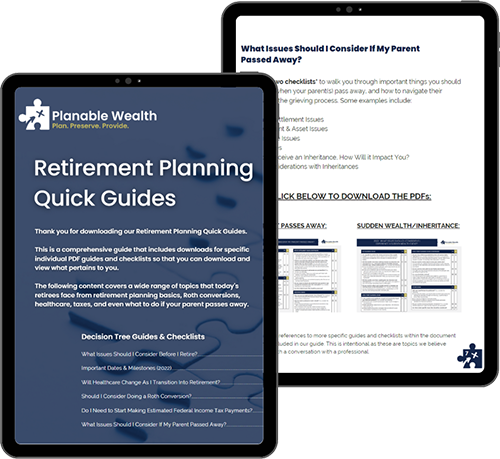
Get your free
RETIREMENT PLANNING QUICK GUIDES [PDF]
Get instant access to several free PDF flowcharts and checklists that cover a wide range of topics that today's retirees face from retirement planning basics, Roth conversions, healthcare, taxes, and even what to do when your parent passes away.
"*" indicates required fields